Hls
#139 Laurie Santos — the Pursuit of Happiness

Bibliography
Highlights
- Episode AI notes
- The pursuit of happiness is often misguided due to misconceptions about what truly brings lasting fulfillment. People often believe that external achievements or possessions will make them happy, but this only provides temporary happiness.
- Affective forecasting errors, where people mispredict their future emotions, can lead to disappointment. Setting specific goals for happiness, such as obtaining a promotion or earning more money, may not always result in the expected level of happiness.
- Even wealthy individuals can have mistaken intuitions about money and experience mental health problems. Becoming a millionaire does not guarantee long-term happiness.
#359 - Getting Used to It

Bibliography
Highlights
#374 - Consciousness and the Physical World
Bibliography
Highlights
- Consciousness Requires More Than Neuron Count
Summary:
Consciousness isn’t determined solely by the number of neurons; the organization of those neurons plays a critical role.
While some theories suggest that consciousness emerges only when a certain threshold of neuron quantity is crossed, observations reveal that individuals can retain consciousness despite significant neuronal loss, such as in the case of cerebellum damage or spinal cord injuries. This indicates that the structural arrangement and complexity of neural connections are essential for consciousness, challenging the simplistic view that more neurons inherently mean more conscious awareness.
Transcript:
Speaker 1
Three or two neurons, or the brain of a human that has on the order of 100 billion neurons. But he was also, Francis was very clear, he said, this hypothesis may not be true. There might be other ways we have to think about it. And he was sympathetic. So for instance, very early on, we encountered Jerry Edelman, another Nobel Laureate who would also move from Manhattan, from the Rockefeller Institute to the Scripps Institute In La Jolla. And he worked with a person at the time, Julia Tononi, who’s now also a very well -known Conscience researcher. And he explored the possibility that maybe it has to do with the complexity. They wrote, for example, an early influential paper called Consoneness and Complexity, arguing that complexity had to be involved, which is a little bit more than just saying it’s Just a bunch of neurons. Because the most widespread belief among neuroscientists is, well, it’s an emergent property, just like wetness emerges from water. You don’t get, if you have two H2O molecules, they’re not wet, but if you got, you know, 10 to the 23, like a liter of H2O molecules, then it gets wet. And similar, if you have a few neurons, they’re not conscious, but you got 100 billion of them, then some of they’re conscious. But then we also, Francis and I realized that’s inadequate because you have some structures, like the cerebellum. So you have this little brain tucked underneath your big brain at the back of your head. It contains, in fact, 80%, four or five neurons in your head are in the cerebellum. You can lose these neurons. Let’s say, due to a stroke or due to two more, you will be impaired. You can’t do fast speed typing on your phone anymore. You can’t play violin or piano anymore. You have a few other issues like that, but basically you stagger both, you look like you’re always drunk. But basically, all these people, these patients who have lost part or whole of their cerebellum, they see, they hear, they dread, they fear, they imagine. Their consciousness is essentially first order unchanged. And so that tells you that it can’t just be the number of neurons. It has to do with at least with the way they’re organized. Same thing with the spinal cord. You can be quadriplegic. You’ve just lost all your spinal cord, 200 million neurons, so you can’t move. But again, your consciousness hasn’t really changed that dramatically. So it can’t just be the number of neurons, it has to be the way they’re organized. And Francis, the hope was similar to what he had accomplished in molecular biology, that if we look at the right neural mechanism in the right way, then suddenly it’ll become apparent,
- Consciousness and Complexity: Quantity Doesn’t Equal Quality
Summary:
An increase in the number of neurons does not equate to consciousness.
Just like a few H2O molecules are not wet but a larger number is, consciousness emerges from complex structures and specific organizational patterns within neural networks. For example, significant impairment occurs when the cerebellum, housing the majority of neurons in the brain, is damaged, yet fundamental consciousness remains intact.
Additionally, individuals with extensive spinal cord neuron loss may become paralyzed but still retain consciousness.
This indicates that the quality of consciousness is related more to the organization of neurons than merely their quantity.
Transcript:
Speaker 1
Don’t get, if you have two H2O molecules, they’re not wet, but if you got, you know, 10 to the 23, like a liter of H2O molecules, then it gets wet. And similar, if you have a few neurons, they’re not conscious, but you got 100 billion of them, then some of they’re conscious. But then we also, Francis and I realized that’s inadequate because you have some structures, like the cerebellum. So you have this little brain tucked underneath your big brain at the back of your head. It contains, in fact, 80%, four or five neurons in your head are in the cerebellum. You can lose these neurons. Let’s say, due to a stroke or due to two more, you will be impaired. You can’t do fast speed typing on your phone anymore. You can’t play violin or piano anymore. You have a few other issues like that, but basically you stagger both, you look like you’re always drunk. But basically, all these people, these patients who have lost part or whole of their cerebellum, they see, they hear, they dread, they fear, they imagine. Their consciousness is essentially first order unchanged. And so that tells you that it can’t just be the number of neurons. It has to do with at least with the way they’re organized. Same thing with the spinal cord. You can be quadriplegic. You’ve just lost all your spinal cord, 200 million neurons, so you can’t move.
- The Limits of Physicalism: Matter May Not Mean Meaning
Summary:
Physicalism posits that the only existing entities are physical in nature, typically understood as matter and energy.
However, this view encounters significant challenges when confronting the emergence of feelings and subjective experiences. There remains a profound struggle in both philosophy and science to explain how consciousness and emotional experiences arise from mere physical components like atoms.
This inability to bridge the gap between physical existence and the qualitative nature of feelings constitutes a critical limitation of physicalism.
Transcript:
Speaker 1
So physicalism, it’s a metaphysical idea that the only thing that exists is physical. Let’s come. I think we have to discuss what is meant by that. But most people have an intuition. It’s matter and energy. Good old materialism. And then the challenge is, well, if you believe that, fine, but then how do feelings emerge? And you know, philosophy has been utterly unable, or science has been utterly unable to explain how any sort of feelings, it feels like something to be me emerges out of atoms and the Void. That’s the biggest challenge that physicalism has utterly failed to me, number one.
- Tagged: #zk #neuroscience
- Time 0:26:46, Open in Readwise
- Note: Physicalism is the idea that there is matter and energy alone, however the greatest challenge of physicalism is the inability to explain feelings, which seems to appear from a void.
^rw791585175
- Reality is shaped by observation, not just existence.
Summary:
The limitations of physicalism become evident when attempting to define what is considered ‘physical.’ Quantum mechanics reveals complexities such as entanglement, where the state of one particle at a distance can instantaneously affect another, challenging traditional notions of locality and material existence.
Furthermore, recent developments in physics indicate that reality is influenced by measurement; different observational protocols yield different realities, suggesting that the act of observing itself plays a crucial role in shaping existence. This participatory aspect of reality raises fundamental questions regarding the adequacy of physicalism as a comprehensive framework for understanding the universe.
Transcript:
Speaker 1
But now the additional evidence for physicalism being inadequate, namely at the bottom, at the rock bottom of physicalism is how do we define the physical. And if you listen to anything in quantum mechanics over the last 30 years, like we all know, it’s deeply troubling and it’s very difficult to define what is the physical. And the fact the physical includes such bizarre things as two particles that are entangled, that are at opposite ends of the universe if you observe one and determine its state instantaneous, Instantaneous the state of the other one is determined. You’re talking about non -locality. Non -locality. So what sort of, I mean, what sort of physicalism is that if things are entangled across the universe? That’s certainly not my grandfather. That’s certainly not Dem, you know, Adams and the Voight. And then, you know, now turns out that the entire school of physics, you know, that does what’s called contextuality or called first person physics, right, where it is where they accept As a fact, as an observation, as an empirical fact, that what exists really depends on what you measure. And if you have different measurement protocols, different things, you measure different things that weren’t there before. So the mere act of observing, the participatory universe, the mere act of observing creates reality. Well, how does that sit with standard of physicalism? So there’s a concept. Let
- Tagged: #neuroscience #zk
- Time 0:29:15, Open in Readwise
- Note: Physicalism falls short because it is difficult to define the physical. For example, quantum entanglement and non-locality tell us that when we observe the state of one particle then instantaneously we understand the state of another, possibly across the universe. This leads to schools of thought where the mere act of observing creates reality, a sort of first-person physics
^rw791585332
#380 - The Roots of Attention
Bibliography
Highlights
- Episode AI notes
- Attention functions as a vital evolutionary tool, operating through three intertwined systems: selective focus (flashlight), broad awareness (floodlight), and goal-oriented coordination (juggler).
- Mindfulness enhances awareness of present experiences, allowing individuals to process unfiltered data about their surroundings and internal states without preconceived notions or emotional interference.
- Mindfulness practice involves three steps: focusing on breath sensations, noticing when the mind wanders, and redirecting attention back to the breath, reinforcing mental strength and habitual mindfulness.
- Engaging with brain networks through mindfulness fosters both understanding and practical access to tools, enhancing one’s agency and capacity for positive change.
- Observing and challenging the solidity of thoughts can help break free from the constraints of mental phenomena, revealing the fluid nature of experiences and offering greater freedom.
- Non-dualistic mindfulness practice transcends ego constraints and structured problems, fostering a deeper engagement with the mystery of existence.
- Illuminate Your Attention: Direct, Broad, and Goal-Oriented
Summary:
Attention is a complex system that operates through three distinct modes: selective focus, alertness, and goal-oriented selection.
The first mode is selective attention, likened to a flashlight, illuminating specific information while excluding others and revealing biases in perception. The second mode, alertness, acts like a floodlight, capturing everything happening in the moment without selectivity, ensuring broad awareness.
The third mode focuses on aligning actions with goals, comparable to a juggler managing multiple tasks simultaneously.
These aspects of attention interact and are supported by different brain systems, forming a critical foundation for mindfulness practices.
Transcript:
Speaker 1
The first system of attention is really regarding sort of selective focus or selection, content-based privileging of some information at the exclusion of other information. And that prioritizing and privileging in the brain, we know, shows up as biased information in favor of what we pay attention to. So this would be something like the brain’s orienting system, as well as aspects of what executive functioning does. But the core thing here is some things matter and our advantage and other things are not. So I refer to this in this kind of metaphor of a flashlight. So if you’re in a darkened room, this aspect of attention would be like having a flashlight privilege wherever it is that you’re directing it toward. And the holding of the flashlight is its sort of endogenous or control capability, that you can move around and guide what you need to do on a sort of piece by piece basis to put together, Making your way out of the room if you’re in a darkened room. So the features of this kind of attention are really narrow, constrained, high signal-to ratio. But if we move away from that system and kind of talk about the next aspect of attention, it’s almost the exact opposite. And it might even tie into what you were describing as awareness, which is formally the brain’s alerting system. So this we could think of as privileging not the content like the flashlight, but the moment. Because really when you think about being alert, it’s about what is happening, the full spectrum of what is happening right now. You can’t save up being alert for later. Low signal to noise ratio, broad, receptive. And sometimes I’ll refer to this as sort of a floodlight. Just everything that is happening without a selectivity is illuminated in this moment for your full conscious access. So narrow, directed, broad and receptive. And then the third aspect of attention, which of course, all of these interact with each other in some way and are supported by distinct brain systems. The third aspect is really regarding goal related selection. So it’s not based on the particular content or the moment like the first two, but what are my goals in this moment? What do I want to be doing? And then ensuring that our actions align with our goals. So something called executive functioning and this system’s job or you might call it a tension control. This system’s job is to ensure that goals and actions are aligned and of course correct when they’re not. And I like the metaphor here of a juggler. So you’re kind of keeping all the balls in the air. You’re not trying to do every single individual task, but you’re overseeing and coordinating. So all three of these in my mind very much relate to mindfulness and mindfulness practice, which I’m happy to talk about next, but just want to pause. Is there anything else you want to ask me about?
- Mindfulness Illuminates Present Awareness
Summary:
Recalling past events, like a recent dinner, involves actively accessing specific memories and focusing attention on particular experiences.
This process highlights the importance of both internal and external stimuli in our awareness. Mindfulness serves as a mental mode that enhances this capacity by promoting purposeful attention to our present moment experiences.
It fosters a state characterized by non-elaboration and non-reactivity, allowing individuals to access raw, unfiltered data about their surroundings and internal states.
Such a mindful approach helps individuals better process and understand their experiences without the interference of preconceived notions or emotional reactions.
Transcript:
Speaker 1
So if I ask you to remember what you had for dinner last night, in some sense, what you’re doing is recalling the episode of last night’s events, pointing the flashlight to the granular Time period of dinner, maybe even visualizing what you had and pulling that out so you have more access to that information. Or it could be captured by a thought, like, oh shoot, did I leave my faucet running or whatever it might be. So I think that the internal-extral domain, as well as this multiplicity of how we spotlight information, is important to think about. Now, the excitement for me regarding mindfulness is that it seemed to cover a lot of this terrain. And the way that I would describe mindfulness sort of most broadly is that it’s a mental mode, a way of making the mind. It’s an intrinsic capacity. You don’t get mindful only by practicing mindfulness meditation. You hold this in what you possess in your mind. And that mental mode is characterized by this sort of purposeful attention to our present moment experience with these qualities of non-elaboration and non-reactivity. So we’re doing our best when we are in a mindful mode of getting the raw data, not an editorialized version, but the raw data of our present moment experience that has both to do with what’s Happening sort of externally and internally.
Speaker 2
Yeah, so again, just to take another pass over that same ground with
- Focus, Notice, Redirect: The Mindfulness Matrix
Summary:
Mindfulness practice can be distilled into three essential steps: focus on breath-related sensations, notice when the mind wanders, and redirect attention back to the breath.
This approach resembles a mental workout, where individuals practice tuning into their present experience, reinforcing mental strength through repeated engagement. By maintaining attention on the breath, practitioners create a framework that helps them identify when they stray from their mental target, ultimately allowing mindfulness qualities to become habitual and automatic in daily life.
Transcript:
Speaker 1
We can talk about the multi-dimensionality, we call it the matrix of mindfulness. But if we just go back to the foundational practice that everybody listening to us can anchor around. So, if it’s something like mindfulness of the breath and the instruction, again, is focused on breath-related sensations, where you’re saying as sensory as possible with regard To those. So in some sense, the flashlight is focused on an anchoring object, which is the unfolding of the breath without manipulating it in any way. And the second part of the instruction being, notice when your mind has wandered away. So in some sense, the floodlight is on, what is happening in my unfolding experience right now? And then the third, which is redirect back, which is essentially, am I on my goal-related task? And for the formal period of time, I’m doing this mindfulness of breath practice, my attention should be on breath-related sensations. So even if you shorthand this, and a lot of our military colleagues will call this our mental push-up, so focus, notice, redirect, and repeat as what might be going on in an unfolding Of a couple 20-minute, 10-minute, 12-minute mindfulness practice. The qualities that you’re talking about become engaged and exercised pretty quickly. And the idea is that the repeated engagement in those aspects are what gets strengthened and allow us to then carry them around, like you said, by default. So being able to have a target for where you should be placing your mind in the backdrop allows you to see when you’re off that target. And part of that requires kind of tuning in to what is the unfolding of my present moment experience. I’m watching it.
- Embrace the Spectrum: From Practice to Understanding
Summary:
Engaging deeply with brain networks fosters a dual approach, blending high-level understanding with practical access to tools for a wider audience.
This engagement underscores the shared goals of knowledge acquisition and accessibility, revealing that the pursuit of understanding the fundamental nature of experience ultimately enhances one’s agency and ability to effect positive change. Through mindfulness practices, individuals can achieve a de-identification from their experiences, enabling a profound shift where the subject becomes an object of observation, facilitating an enhanced awareness and perspective on their unfolding lives.
Transcript:
Speaker 1
Well, it’s interesting because this is almost exactly the kind of conversations that Cliff and John and Antoine and I had for four years as we were writing this paper. And it is funny because while some of those folks, actually all three of them, have spent a lot more time with the more intensive adept practitioners, I’m on the other side of the spectrum, Frankly. I mean, the way I can talk to you about brain networks and I’m certainly very interested in the fundamental nature of what is happening and changing, my core interest is in improving Access, implementation access to these tools to as many people as can be reached. And I don’t actually see the goals as highfalutin versus every day. I see them as the same because of what you’re saying is that in some sense, as you get closer and closer to understanding the actual nature of not the ordinary subjective experience that You have, but the actual nature of what is happening that gives you that your building blocks for experience, you have more agency to do something differently that might actually advantage Your life and your functioning. So I connect the dots often. But to go back to your question regarding the, in some sense, I think you’re talking about non-dual practice now, but going from the notion of a subject-object distinction, right? So let’s even just, let’s just, I’m going to throw some terms out and you know, you can clarify as you have been if you don’t mind. So if one aspect of what emerges as we practice mindfulness is a better ability to become de-identified or dis-identified with our experience so that we’re watching what is unfolding. That is oftentimes referred to as de-centering. We’re not that we’re a fly on the wall or we’re hovering above, we’re watching what’s occurring, not from the direct eyes of I, but we’re turning the subject into object.
- Break the Illusion of Objectness
Summary:
Mental phenomena can act as constraints, akin to a straitjacket, by defining how we perceive ourselves and our experiences.
We often believe we are fixed in certain ways or shaped by external circumstances. One approach to overcoming these limitations is to observe our thoughts.
A more advanced method involves challenging the solidity of these mental constructs, recognizing that they are an illusion we create.
Understanding that the nature of these mental events is fluid rather than solid allows for greater freedom and flexibility in our thoughts and experiences.
Transcript:
Speaker 1
We hold these mental phenomenon that can actually really tie us down and constrain us. Whether it’s something like, I’m this kind of a person or I always experience X, Y, or Z, or life has handed me this kind of set of factors, we’re constrained by that. It’s like a straitjacket. So one approach is, okay, at least watch the mind. The other approach, which we could call maybe more advanced, we could call it as a different approach, which I think takes more practice, is challenge the notion of objectness. Actually see that that holding together of mental events is illusory. I mean, you made it up. I mean, and there’s something that actually drives in the brain that happening, but that actually its nature is intrinsically not solid.
- Embrace the Mystery Beyond Duality
Summary:
Dualistic practitioners of mindfulness tend to return to identifiable problems and a sense of ego, often able to articulate their sense of unfulfillment.
In contrast, non-dualistic practitioners, when faced with the same questions about their state of enlightenment, experience a deeper engagement with the mystery of existence that transcends structured problems, regardless of their emotional or physiological states. This engagement points to a profound understanding of being devoid of the usual ego constraints.
Transcript:
Speaker 2
Like, when a dualistic and non-dualistic practitioner are both lost in thought, well, then they’re both lost in thought. But the difference is when they’re no longer lost, when someone snaps their fingers and says, come back, what can you realize now? The dualistic practitioner of mindfulness returns to the problem in some sense, the problem of having to pay attention for a reason. Now granted, it can be very it can be very pleasant, it can taste like a certain kind of freedom, and that’s great, and that’s, that really is true. But if you were to ask a dualistic practitioner of mindfulness, like, how in this moment do you know that you’re not a Buddha already? Right? How do you know you’re unenlightened? He or she can usually tell you, right? I mean, you can find the thing that proves to you that you’re still just this kind of ego bound meditator still trying to work it out and untie the knot of self. Whereas, once you can actually practice non-dualistically, to be asked that question is to be confronted by the just the pure mystery of being in that moment, which is not structured In the way that gives any evidence of a problem. And that’s true even if the physiology of some negative state is still present. So let’s say you were angry a moment ago and then all of a sudden you become mindful.
#382 - The Eye of Nature
Bibliography
Highlights
- Unlocking the Genetic Book of Life
Summary:
A future zoologist, envisioned as Soph, may master the art of reading animal genomes to unravel complete ancestral histories, an ability currently unattainable.
Presently, predicting an animal’s phenotype from its genotype remains a significant challenge, emphasizing that much of the exploration focuses on understanding phenotypes to glean insights into ancestral stories. The distinction between genotype and phenotype is crucial; while genotype refers to the genetic makeup, phenotype encompasses the observable traits and behaviors stemming from that genetic foundation.
Transcript:
Speaker 1
Okay, I have a sort of recurrent fantasy about a zoologist of the future, scientist of the future. I make her female and I call her Soph, scientist of the future. And I believe that scientist of the future will be able to read the book which is the animal and its genes, and piece together the entire palimpsest of its ancestral history. It’s something we can’t do at the moment. And the part of the book is, parts of the book are about the little preliminary, fumbling steps, nursery slopes steps, which we can make towards that end.
Speaker 2
Given an unspecified genome, how close are we to being able to predict the phenotype of the animal?
Speaker 1
Not very close. And that, of course, would be a big problem for the genetic book of the dead. And much of the book actually is not about genes at all. It’s about using the phenotype of an animal to reconstruct the book, which is its set of ancestral histories. Soff in the future will be able to do it with the genes. And we can’t really do that now. There is no decoding process whereby you can get a genotype and say what the ancestral worlds of this animal were.
Speaker 2
I think, Richard, we should probably remind people of just… We should define our terms here. What’s the difference between a genotype and a phenotype?
Speaker 1
Well, a genotype is the set of genes in the animal, and the phenotype is what the genes manifest themselves as. So the phenotype is the body, its behavior, everything that we actually see of the animal.
#388 - What Is Life?
Bibliography
Highlights
- Standard definitions of life, focusing on self-sustaining chemical systems capable of Darwinian evolution, have limitations.
- Examples like individual organisms, memes, technology, and viruses challenge these definitions, raising questions about the fundamental nature of life.
Transcript:
Sara Imari Walker
So I wouldn’t say that I agree with these kinds of definitions, but the one that you’ll usually see in astrobiology is that life is a self-sustaining chemical system capable of Darwinian Evolution. And at first pass, that seems pretty reasonable because you’re talking about life being chemical systems that can evolve. But as I talk about through like the first chapter of the book, you know, like if you focus on each word in this definition, they fall apart at some level. And there are really simple things like evolution only happens to populations. So are individuals alive or not? Is life chemical or not? You know, we can think about memes as evolving systems or is technology actually a part of life or not. Viruses are kind of a typical definition. They’re not self-sustaining or challenging. They typically challenge definitions. They’re not self-sustaining on their own. Are they alive when they’re in the cell and not alive when they’re out of the cell? And even self-reproduction is a bit problematic. So there’s always the examples of things like mules. But I like honeybees as a better example because it’s very clear that a colony of bees is a living thing, but you have individual members of the colony that can’t reproduce.
- So I maybe don’t agree that we actually even have narrow forms of intelligence. I think it’s very easy for us to recognize things we think of as intelligence because we see ourselves mirrored in our technology, but the technology has been selected to mirror us. So it’s very unclear to me how much the substrates themselves are embodying things that we might view as intelligence versus being kind of a false mimic to us.
- Information plays a crucial role in defining the boundary between life and non-life.
- Information is a physical feature of reality, not just an abstract property, and must be considered in the study of living systems.
Transcript:
Sara Imari Walker
So information to me is certainly related to the boundary between non-life and life. And early in my career, when I first started thinking about the original life and really thinking that theoretical physics was the right approach for addressing the transition from Non-life to life, my first sort of sets of conjectures about this were that life is where is the sort of boundary in the physical universe where information has to take on a causal role, You actually have to consider it as a physical feature of the
1 Relax and Release. Teaching Weekend. Geneva, 2019 Saturday Part 1

Bibliography
Highlights
- If we remain settled, when the mind is moving, if you don’t get involved, you start to see, I don’t have to be involved. Habitually dependent on my thoughts and feelings to give me the sense I am me. But when I don’t do that, I can be reborn. That is to say, I am not who I think I am.
- Tagged: #spirituality #zk
- Time 0:05:31, Open in Readwise
- Note: If we remain still within the swirling of our minds, we begin to see that we are not dependent on our thoughts and feelings to define who we are, meaning we can redefine who we are.
^rw798349016
2 Relax and Release. Teaching Weekend. Geneva, 2019 Saturday Part 2
Bibliography
Highlights
- Dharma is the study of the ego and how the ego obscures open awareness.
- Thoughts exist within the mind, similar to a reflection in a mirror.
- They are inseparable, just as a reflection cannot exist independently of the mirror.
Transcript:
Unknown Speaker
When you really see, my mind has content, but the content is not the same as the mind, it’s not other than the mind, it’s like the reflection in the mirror. You never have a reflection without a mirror. The reflection is always in the mirror. You can’t take the reflection out of the mirror. So, you never have thoughts without a mind. The thoughts are, as it were, in the mind. And you cannot take the thought out of the mind.
- The Depression Triangle consists of three negative beliefs.
- These are: believing there’s nothing good in oneself, the world, and the future.
Transcript:
Unknown Speaker
Aram Beck, one of the founders of modern cognitive behavioral therapy, one of the first useful things he did was he developed what he called the Depression Triangle, which is the three Points on the triangle. So it’s three beliefs. One is, there’s nothing good in me. Second is, there’s nothing good in the world around me. Third is, there’s nothing good in the future. And when these three factors lock together, this is high direction towards depression, hopelessness, and eventually suicide. Because I’m crap, everything’s crap, and the future’s gone.
- Use meditation to confront rigid definitions and ideas.
- Stay with these constructs long enough to see their ephemeral nature and experience a sense of liberation.
Transcript:
Unknown Speaker
So this is what meditation is for, is to bring us to the point where we directly sit with these intense, compressed definitions, ideas, and we stay with them long enough to see that they Dissolve. That actually they are ephemeral. They are like a dream, like a spider’s web, like a rainbow in the sky. There is no substance to them. But if you just glance off them, they seem to be real and real and real. So we sit and we allow the dissolving of the constructs of the mind and then we find we’re naked, fresh, alive, available.
4 Relax and Release. Teaching Weekend. Geneva, 2019 Saturday Part 4
Bibliography
Highlights
- Non-Duality of Mind
- The concept of non-duality is illustrated using the example of a mirror and its reflection, and ocean and waves.
- They appear as separate entities, but they are inseparable and exist simultaneously.
Notes:
- This relates to Alan Watts talking about environment and organism being the same.
Transcript:
Unknown Speaker
There is a mirror and there is a reflection. I’ve got too much of one and not enough of the other. But the fact is that the mirror and the reflection are non-dual. They come together. They are at the same time. Or another traditional example, in the ocean you have waves. When you go to the sea, you see these waves coming up and going down. There is the ocean and the wave. But clearly, the wave is not different from the ocean. Now, if you say the wave is the same as the ocean… You’ve put both into a blender of some kind, because you’ve lost the precision of now the wave is arising. And you can feel that, oh, oh, I’m rippling sometimes. So there is a wave and there is an ocean. But what we have is wave ocean, wave ocean. And the wave and the ocean are not two, and they’re not one. So when you really see that, that’s the meaning of non-duality. Of course, the wave and the ocean are just water.
- Uncontrived Presence
- Uncontrived presence is achieved by not going anywhere else mentally.
- It’s the act of going somewhere else, like daydreaming or getting distracted, that requires effort.
Transcript:
Unknown Speaker
We find ourselves in that, as that, by not going anywhere else. So we’re here intrinsically without effort because we haven’t gone anywhere else. It’s the going somewhere else that takes the effort. You put energy into daydreaming or being distracted or preparing or trying to remember what you have to buy from the shops before they close. All kind of things can catch our mind. This is uncontrived. When you stop contriving, when you stop being artificial, when you stop art, when you stop constructing and making, nothing to do. It’s here. It’s already here. I am inside the being here-ness. So this is very different from the view of many Dharma practices that say we are wandering in samsara, we are lost, we are confused, we have def poisons. We’ve accumulated so much karma. We have to purify ourselves. We have to gather merit and wisdom. There’s a lot to do. You say, don’t do any of this. Don’t do anything. Some of us remember from Siyalama’s prayer, Mach Dharmakaya, the mind of the Buddha, is free of all positions and
424 Dissolving Attachment in the Openness of Being – Macclesfield 04-05_02_2017 12
Bibliography
Highlights
- Embrace All Emotions for True Connection
Summary:
Acknowledge that despair, hopelessness, and meaninglessness are integral parts of human experience, just like happiness and joy.
Attempting to shield oneself from these darker emotions leads to isolation and intensifies the struggles of those enduring despair. Embracing the full spectrum of emotions fosters genuine connections and helps others find paths out of their sorrow, ultimately contributing to a more compassionate understanding of life’s complexities.
Transcript:
Speaker 1
This is a kind of public relation, stuff that’s getting Buddhism very, very confused. The idea that you can become happy in a world where disasters are happening is disgraceful. You know, a Buddhist monk called the happiest man in the world. I mean, this is shameful because if you’re alive, you’re going to be touched and moved. We’re going to feel sad. We’re going to feel despairing. We’re going to feel hopeless. These are colors on the palette of life. We don’t need to paint with them all the time, but if you’re trying to protect yourself against despair, you’re cutting yourself off from people who feel despair. And if you cut yourself off, they’re left in their despair, and so it’s more likely that their despair becomes a totalizing, a totally defining feature of their existence, and that’s The sort of thing that drives people towards suicide because they can’t find a way out. Whereas if we start to see that despair, hopelessness, meaninglessness are just as much part of life as happiness, playfulness, feelings of camaraderie and inclusion, then we start To see what the potential means. Everything is part of me.
452.London.Public.Talk.18.01.18
Bibliography
Highlights
- Perception Shapes Reality
Summary:
The sense of self is constructed through a myriad of influences—including past behaviors, family dynamics, personal experiences, health, and societal perceptions—creating a distorted projection of reality.
This habitual filtering impedes genuine interaction with the world. However, achieving unmediated responsivity is possible through the practice of non-duality, where the divisions between self and other dissolve, allowing for a more authentic engagement with life.
Exploring pathways to reach this state requires intentional contemplation.
Transcript:
Speaker 1
That’s what happens when we construe things through the filtering system of the habitual construction of our sense of self. Patterns generated from the Buddhist mind of view, from the impact of our behaviors in previous lives, the constellation of our family, our birth experience, how the mood was in the Family, schooling, occupations, whether we’re healthy or unhealthy, whether the world sees us as attractive or not. All of these factors lead to little prisms of self and each moment is refracted through these prisms and so we have this complex projection of appearances which we then take to be strongly Real. This is our normal situation. The possibility is to move into an unmediated responsivity so that as the world is arising, we are manifesting with that world. That’s what’s normally described as non-duality, in which the barrier or the separation between self and other is less operative. So then we have to think, okay how would we get there?
- Understanding Reality Requires Unlearning Labels
Summary:
The mind’s energy manifests as subject and object, creating dualities such as experiencer and experienced.
This results in a deeper ignorance tied to identification, where subjective labels and descriptions obscure true reality. As individuals develop concepts and classifications, they mistakenly believe they gain clarity and power.
However, from a Buddhist perspective, this process leads to a delusion, as all descriptions are mere creations rather than accurate representations of existence.
The understanding of reality is hindered by culturally reinforced conceptual elaborations, prompting a need to unlearn these labels to recognize the true nature of experience.
Transcript:
Speaker 1
Appearing to fragment because of these pulsations of energy. The energy is the energy of the mind, which we can start to explore in meditation and if you come at the weekend we’ll do this in more detail. As this thickening of the energy arises, it starts to manifest in the form of subject and object. There is, seems to be, an experiencer and an experienced. This leads to the second level of ignorance, which is the ignorance of naming everything, of identification. So, I am like this, you are like that. This is an oak tree, this is a birch tree. Coffee doesn’t taste like tea. And the more you go into conceptual elaboration, the more you go into developing concepts, it is as if you are gaining more power to identify and describe what is there. From the Buddhist point of view this is the force field of the great delusion that we live within. Because what is actually happening of course is that there is no such thing as description. All description is creation, that the world comes into being according to our means of constellating experience and the more that constellation is coming through our culturally Approved, reinforced through education,
800 - Puzzle Palace

Bibliography
Highlights
- Episode AI notes
- The manufacturing consent machine is broken and shows a disregard for public sentiment and influence.
- The daily death toll in Gaza has decreased by half due to a change in war strategy and international pressure on Israel.
- Israel’s response to international pressure contradicts claims of wanting to maximize civilian deaths.
- The ongoing conflict in Gaza continues to cause enormous damage while Hamas persists in attacking Israel.
- The Decline of Deaths in Gaza amid Ongoing Tragedy
Summary:
The daily death toll in Gaza has fallen by half in the past month, reflecting a change in war strategy.
International pressure has influenced Israel’s response, indicating a significant shift, although the war is not over and further tragedy is anticipated. The conflict continues to inflict enormous damage on Gaza, while Hamas persists in attacking Israel and calling for its destruction.
Transcript:
Speaker 1
Then and then I just want to mention quickly the headline in the New York Times today in this article by David Leonhardt The headline is the decline of deaths in Gaza the daily death toll In Gaza has fallen in half over the past month Reflecting a change in war strategy and then at the very end of this article where it just says the bottom line The New York Times and the not An opinion column writes Even with the caveats the change in Israel’s war strategy has been significant and somewhat overlooked Israel has responded to international pressure in Ways that suggest its harshest critics are wrong to accuse it of wanting to maximize civilian deaths Yet the war is not over Israel continues to inflict enormous damage on Gaza and Hamas Continues to attack Israel and call for its destruction The war’s next phase will almost certainly include further tragedy and my point about that is like Obviously like look like
Speaker 2
As many people point out that war is going to have more tragedy.
Speaker 1
How you don’t say Yeah, it like to be for yeah, exactly like go to be sure there’s more tragedy to come But just less tragedy than you’ve seen on the news already the rate of tragedy falls
Speaker 3
Over But like what I mean about this Yes
A Satire of the Sunshine State

Bibliography
Highlights
A System for Writing: How an Unconventional Approach to Note-Making Can Help You Capture Ideas, Think Wildly, and Write Constantly - A Zettelkasten Primer
Bibliography
- Author: Bob Doto
- Full_Title: A System for Writing: How an Unconventional Approach to Note-Making Can Help You Capture Ideas, Think Wildly, and Write Constantly - A Zettelkasten Primer
- Category: books
- Document Tags: [ productivity, ]
- Last Highlighted Date: 2024-10-05 01:27:07.221878+00:00
Highlights
- Fleeting notes form the basis for much of what you’ll create inside your zettelkasten, though they themselves will not make it past the velvet rope. Fleeting notes live in a state of potential, waiting to be transformed into more useful “main notes,” the notes that will make up the bulk of your zettelkasten.
- Any notes that seem hard to process, but are still relevant to your thinking, should be moved to a “Sleeping” folder.
- depending on how feverishly you capture thoughts, it’s possible the majority of your fleeting notes will end up either in the waste bin or ignored.
- Note-taking is writing, and writing is a path toward knowing. Taking fleeting notes is the first step in knowing what you think and believe.
- A reference note is a single long-note containing brief citations or “references” to what caught your attention while reading a book, listening to a podcast, watching a video, or having a conversation.
- As you spend time working with your zettelkasten, you’ll begin gravitating toward ideas and passages in your reading that speak directly to others already stored in your slip box.
- Read with a question or problem in mind.
- Capture ideas you disagree with.
- Capture what you think about what the author thinks.
- Reader-response theory posits that no one person, not even the author, has a monopoly on the meaning of a text. Rather, meaning is created through the act of reading.
- Capture someone else’s interpretation.
- Don’t forget fiction.
- Go wild with your captures.
- The most important thing about any form of reference note-making is to, at some point, return to the note. It’s the “going back” that makes all the difference, understanding that your initial scribble isn’t the end of the capture. It’s the beginning. A reference note is to be used as a reference. Its contents to be transformed into main notes.
- Like fleeting notes, not everything you capture in a reference note need be transformed into a main note.
- If you tend to read digital books, you can still do the steps above, but also have the option of using one of the many “read later” apps to store your highlights and notes. If you use this approach, I recommend bringing these captures into a separate reference note file, as notes stored in read later apps can quickly pile up and become unpleasant to work through.
- In its most basic form, a main note should have at least two components:
• a single idea, and
• a link to another idea stored in your zettelkasten
- Other elements that can be included in your main notes are:
• a title
• a quote or reference to where the idea comes from
• a record pointing to where and how the idea has been used in your writing
• a unique ID
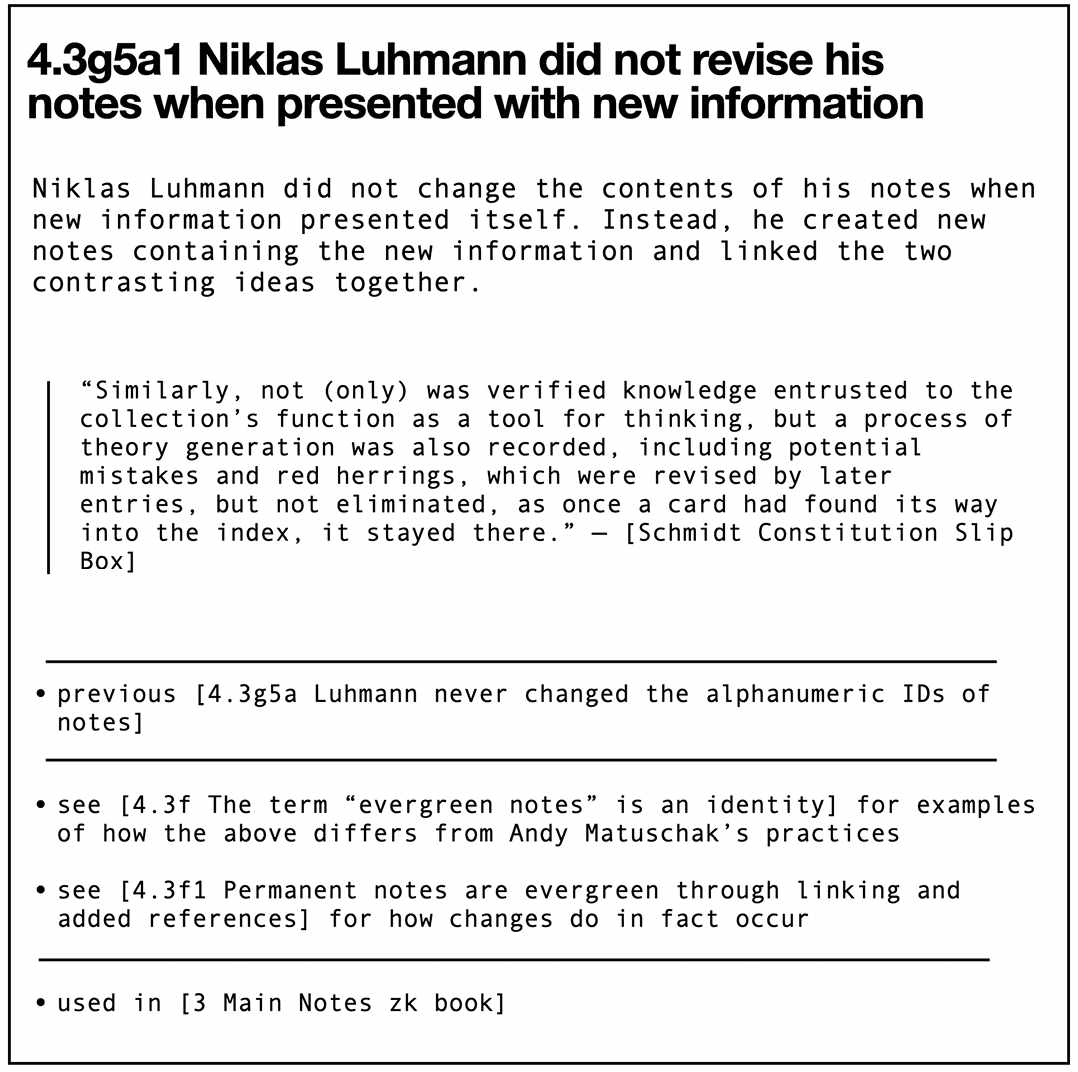
- A main note works best when the thought contained inside has been pared down to its essentials. Having a single idea to contend with means you won’t be sifting through counterarguments and varying points of view. Instead, you’ll be dealing with a single unit of information that freely associates with others (4.5)
- Links are used to establish relationships between ideas. By connecting thoughts, we give ourselves options, turning isolated, single-idea notes into long-form trains of thought.
- A title acts as a condensed thesis summing up the content of the idea stored in the note.32 It should be a declarative statement rather than a descriptor.33 “Not all apples are edible” is a better title than “Apples and edibility.”
- Whenever you have an idea that’s built off of, or speaks directly to what someone else has said, bring the quoted passage into your main note.
- The more connections you make, and the more writing you create from these connections, the more important it’ll be to track how and where an idea has been used in your writing.
- alphanumeric IDs, sometimes called folgezettel,36 give notes a permanent identity that can be referenced regardless of any changes made to the note’s content.
- Processing Your Inbox and “Sleeping” Folder
- If the idea is one you aren’t ready to examine, send it down to your “Sleeping” folder
- Creating Main Notes from Fleeting Notes
Retype or copy/paste the idea into a new file, rewriting it if necessary, using complete sentences that capture the crux of the thought you’re trying to convey. Consider if/how this idea relates to another already stored in your zettelkasten. If the idea is unrelated to anything else, edit the idea so it’s readable, and import it without linking the idea to others. If the idea relates to another already networked in your slip box, either rewrite it to speak directly to the other idea, or reference the previously captured idea and state why you’re making the connection.
- Creating Main Notes from Captures in a Reference Note
The first thing to do when creating a main note from a reference note citation is to retype, copy/paste, or reference the quote you want to comment on in a new note.
- Creating Main Notes from Your Own Writing
While it may seem obvious that main notes will be created from passing thoughts and other people’s ideas, your own writing can also be used as a source for main notes. Blogs, articles, newsletters, tweets, emails, and comments on forums can all be parsed out and repurposed as main notes to be reused in other pieces of writing or thought work.
- If, when making a main note, a new idea comes to mind, take advantage of the opportunity to add it to your zettelkasten.
- It’s perfectly acceptable to incorporate questions into your zettelkasten, since these can serve as both placeholders for future answers and prompts for shorter writing pieces. But, questions left unanswered are a somewhat low-value form of content. After all, how will a question help you in your writing if you don’t know the answer? Where is the idea you want to get across? In order for questions to become useful, they need to be transformed into something usable.
One way to level-up a question is to embed it in a declaration. To do so, ask yourself why the question is important. What feelings does the question bring up? Is the question common?
- If you don’t know the answer, say what you know about the question.
- Whether you’re involved in a technical field, doing academic research, or just trying to keep track of what others have said about a topic, there are a variety of reasons why you may want (or need) to capture facts, definitions, and/or technical data in your zettelkasten. The trick is making this information usable and high-value.
- Restate facts in your own words.
- To enhance the value of captured facts, it’s best to rephrase them in your own words.
- Consider creating new notes so you can speak about the facts. By providing additional commentary, you can better integrate the information into your broader understanding of the topic, enhancing both your comprehension and your ability to write about the topic effectively
- Don’t be afraid to make it personal. You never know the value of a note until it relates to its familiars (3.7:2). The important thing is to bring the fact into contact with your own thinking.
- Regardless of the different kinds of information captured in a main note, creating these notes is generally achieved in one of two ways:
- Developing an idea “in light of” what’s already stored in your zettelkasten
- Developing an idea “in spite of” what’s already stored in your zettelkasten
- There’s always the possibility newly captured ideas will contradict or challenge others previously imported into your zettelkasten.
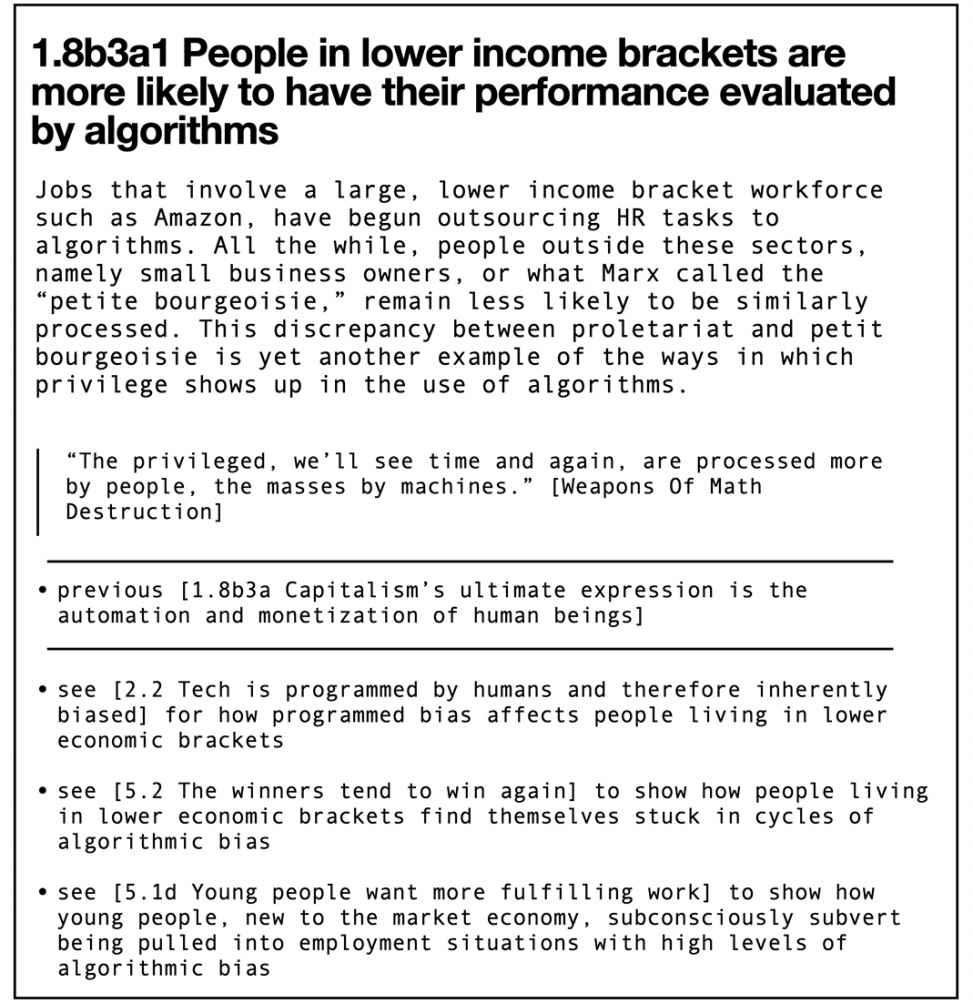
- Niklas Luhmann didn’t revise his notes when new information presented itself that contradicted previously captured thoughts.
- Instead, create a new note containing the counter argument, state why this new idea bests its predecessor, link the new note to the one it challenges, and import it into the zettelkasten.
- Must each main note be a perfect summation of your current thinking? The short answer? No.
- Relationships between ideas are what give them value.
- You don’t need to have it all figured out when creating main notes. Individual main notes don’t need to be perfect representations of your current thinking. They don’t need to contain the latest information, nor “all the links.”
- By interrogating ideas captured in main notes, new relevancies can be brought to light.
- At first, it may feel like the connections you’re making are strange, even forced. And, at times, they may be. But, as you add more notes, the ways in which ideas relate will become clearer.
- establishing relationships is the same: interrogate the content of your ideas. Read the subtext. Stretch their relevancy.
- What level of atomicity works best for you is personal. As a PKM comrade of mine has said, “make a note that contains the fewest number of pieces as necessary to be useful for its specified task.”
- Working with a Luhmann-style zettelkasten is, in part, a practice of decomposition, where a writer’s previously structured thoughts are disassembled, to be networked in the slip box, and reassembled later in new ways as a “mosaic of quotations.”53
- Sometimes one idea is really two.
- One rule of thumb is to keep an eye out for when “but” and “however” show up in your note-making. Whenever I write either of these two words while making a new note, I pause and ask myself, “Should what comes next be a new note?” The answer is (almost) always “Yes.”
- Embracing and leveraging the symbiotic relationships between connected ideas is the means by which we engage (and locate) our notes.
- Seeing folgezettel as a means to create hierarchy misinterprets what’s happening inside the zettelkasten. We aren’t connecting notes. We’re establishing relationships between ideas contained inside the notes.
- Folgezettel forces you to connect newly imported ideas.
- “Eufriction” is good friction.
Just as weight training, writing a book, and giving birth are considered forms of “eustress,”70 that is high-intensity activities that have beneficial results, so too is folgezettel a form of “eufriction,” a slowing down to better engage with the work in front of you.
- The main compartment of the zettelkasten is an anarchy of ideas: a personal knowledge base without hierarchy, without centers of power, without top-down structure.
- Luhmann believed non-hierarchical organization led to non-normative ideation. This, however, doesn’t mean Luhmann always engaged with the rhizome in its raw, anarchic state.
- Over time, recognizable areas of your zettelkasten will develop around particular themes and subjects. Hub notes help point toward the various places your thinking has gone, functioning as “access points,”78 or “highways between topics.”79
- Creating a hub note is relatively simple. First, choose a section of your zettelkasten where the theme has been taken into a variety of places via different trains of thought. Once you’ve decided on a section to work with, create a new note, and give it a name that identifies the topic you’ll be exploring. Next, identify which notes within the section initiate the various trains of thought.
- In contrast to hub notes, which contain lists of notes pointing toward trains of thought developing in your zettelkasten, structure notes are spaces where the contents of those trains of thought can be developed further. In order to see how your ideas relate semantically—how they might function as a coherent train of thought—they need to be exported to a place where you can unpack them. Structure notes are where this happens.
- Creating a structure note can be as simple as organizing a list of notes or ideas in a way that makes sense, added to over time, as new ideas come into the zettelkasten.
- This initial gathering of notes gives you something to work with. Once you’ve collected a few ideas, begin organizing them in a way that makes sense, giving context for the choices you make. Then, look through your zettelkasten for other ideas that speak to the developing theme of the structure note, once again giving context to the notes you’ve included. Fig. 44 shows what an evolved structure note can look like.
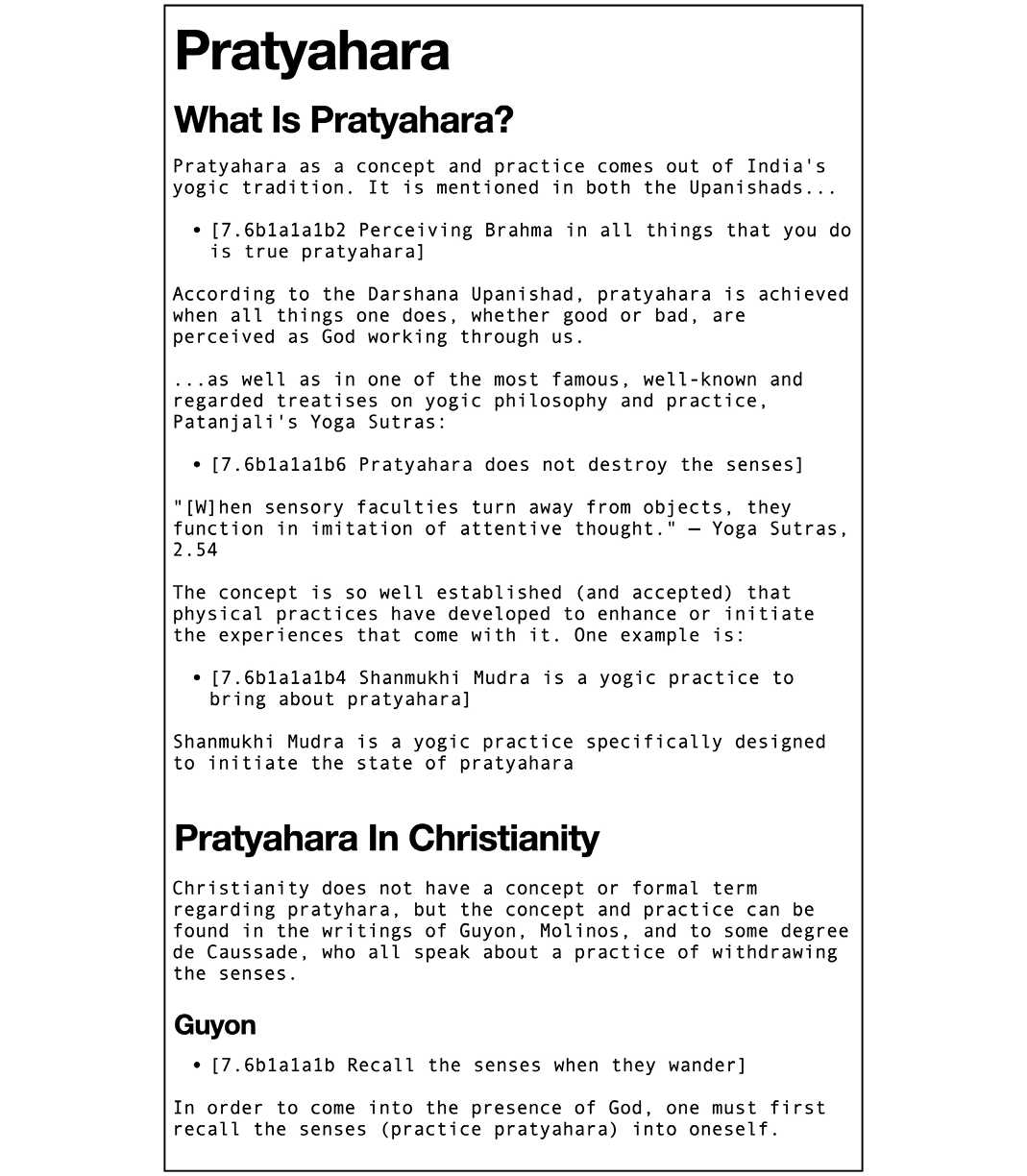
- Taking the time to organize and explain the relationships between the ideas you’ve collected will help you understand your own thinking on the topic, while at the same time leading to additional thoughts that can also be included in the structure note. You may also uncover areas of your thinking that lack substance or are missing completely.
- Hub notes and structure notes are, by design, relatively prescribed ways of engaging with the zettelkasten. Niklas Luhmann’s keyword index,87 on the other hand, functioned like an oracle.
Luhmann’s keyword index wasn’t exhaustive. At most, each listed keyword had only four references to where the term could be found (in a slip box containing over sixty thousand notes!). The assumption was the references in the notes would be enough to direct Luhmann where he needed to go once he entered the slip box.88
- Indexing is personal.93 Whether you choose to embrace Luhmann’s penchant for serendipity by creating a keyword index that only hints at what you’ll find, or decide to create something more comprehensive and explicit, the index you keep need only serve your purposes.
- Regardless of which approach you take, keywords need not only speak to topics and themes. They could also point toward emotions and experiences. If you want to feel your way through your ideas, you might include indexed references to “Ideas that make me laugh” or “Ideas that make me want to change the world.” You might also include references to repeated situations in which certain ideas arise: “Ideas that arise in therapy,” or “Morning walking thoughts.” So long as your index helps you engage with your zettelkasten, it’s a functioning index.
- Rather than structuring his zettelkasten around topical categories or as a hierarchical tree structure, Luhmann chose instead to allow his compartment of main notes to develop bottom-up, its structure emerging out of the relationships between ideas, sections emerging over time.
- There’s no need to be overly comprehensive with what you include in your high-level views. Let yourself be surprised by what you encounter.
- Clusters of ideas forming inside the zettelkasten are suggestions, not mandates.
- Imagine taking notes on a book about homesteading, thinking you’re going to write articles on the history of back-to-the-land movements in the United States, only to find the majority of the citations in your reference note came from a chapter on basket weaving. When the majority of your captures have to do with weaving baskets, even though you’ve ne’er a basket weaved, at some point you have to face facts: you’re interested in woven satchels. It’s in this way that reference notes show us our real interests as opposed to those that are mere wishful thinking.
- Structure notes provide a foundation for writing.
- Sometimes an idea just wants to move, so much so that any attempt to capture it in a single note proves a hopeless endeavor. Whenever I encounter a runaway idea, I have a choice to make:
• Break the long-note into several main notes, or
• Convert the long-note into an article
To make it easy, I do both (Fig. 46).
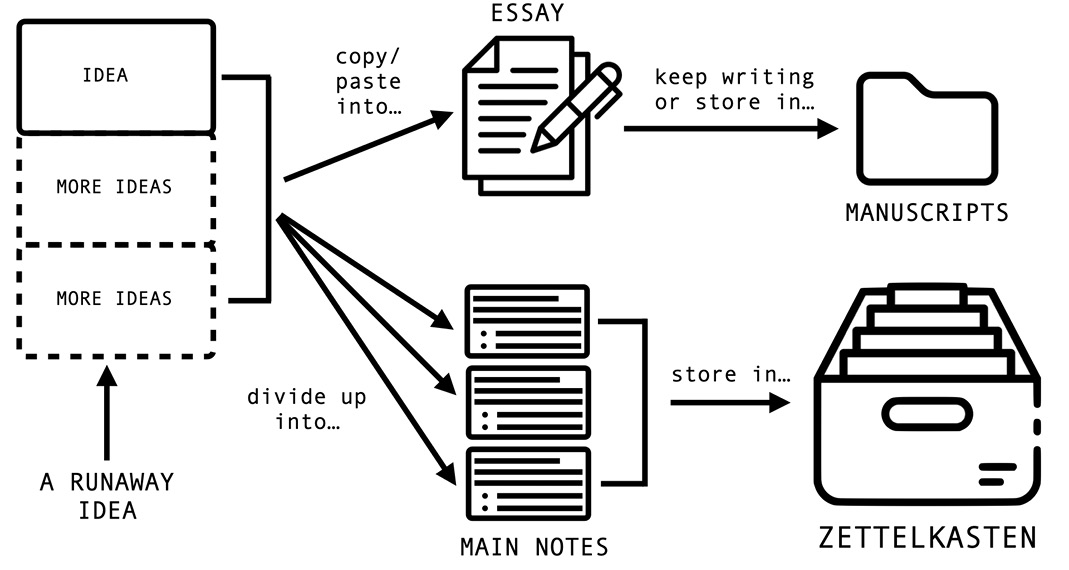
- Always take advantage of inspiration. If capturing an idea turns into writing an article, continue writing the article. After you’ve finished the piece or taken a break from writing, go back and find the ideas that didn’t make it into your zettelkasten, turning each one into a main note
- All the examples in this chapter show how a zettelkasten can point toward what to write about. None, however, suggest the zettelkasten should do the writing for you. And, the reason is simple: Your zettelkasten is a terrible writer.
The ideas you’ve been capturing in your main notes weren’t written in the context of any one specific piece of writing. These ideas need to be framed in light of the subject you’re writing about, the overall theme of the work, and your chosen tone. Ahrens reminds would-be writers to avoid copying notes into manuscripts, stating that writers should instead “[t]ranslate [ideas] into something coherent” by embedding the ideas “into the context of the argument.”98 This is advice worth heeding.
- Aside from unchecked (and undeserved) hubris, one of the reasons why working with a zettelkasten often leads to poor writing has to do with fragmentation, or as Richard Griffiths at writingslowly.com puts it, “the illusion that disjointed fragments can produce integrated thought.”123 Despite the connections you’ve made and the reasoning you’ve given for each one, relationships between ideas must be reframed in the context of the piece you’re working on. This means rewriting ideas, shaping them to express what you want.
- Your first paragraph can probably go.
- Lean into your footnotes and endnotes.
- Not every note in a train of thought need be brought into your manuscript.
- What you don’t include can be used elsewhere.
- • Take advantage of runaway ideas by transforming long, complex notes into rough drafts. Then parse out your ideas into individual main notes.
• Don’t let your zettelkasten write for you. Develop your writing craft by editing your ideas and unpacking and expressing the relationships between them.
- So long as your ideas remain hidden from view, they lack the substance that can only come from reader engagement. Meaning is created in community.127
- The easiest (and quickest) way to get feedback on ideas is to transform them into tweets, toots, and other short-short forms of online content.
- Do not use the convenience of main notes to “ship” prepackaged ideas. Get into the mix of discourse. Your zettelkasten is a catalyst, not a substitute, for creativity.
- one person’s procrastination is another person’s cognitive reset.
- Niklas Luhmann worked on multiple manuscripts simultaneously, which allowed him to avoid writing “blockages.”
- While some of the most well-known slip boxes in the world have been employed by writers in service of their writing,144 a zettelkasten can also be used without writing as an end goal.
Alan Watts Mix

Bibliography
Highlights
- Embrace the Subtlety of Liberation
Summary:
Embarking on a journey towards liberation often brings forth unseen challenges, as one’s karmic debts resurface.
This can manifest as unexpected hardships, such as health issues and financial losses, reflecting the principle that declaring intentions may draw attention from those owed. The concept of ‘wu wei’ embodies the wisdom of non-interference and allowing events to unfold naturally, suggesting that sometimes one should act subtly without fanfare to navigate these karmic entanglements effectively.
Transcript:
Speaker 1
Off your karmic debts. And so the moment you set your foot on the path of liberation you are apt to find that all your karmic creditors will come to your door. And that’s why it’s often said that people who start out on a serious work of yoga suddenly get sick and lose their money and their best friends drop dead and all kinds of ghastly things Happen. That’s because you see they served notice that they were going to do this. And so all the creditors came around. If you’re gonna leave town and you own lots of money you know you mustn’t announce that you’re leaving or give a farewell party to your friends because the grocer will find out. So the art of the sly man is to make no contest but simply to leave without one word. In other words, that’s the meaning of wu wei in the technical vocabulary of Taoism. Wu wei, not to interfere, not to force things. That’s the best translation of wu wei, not to force things. But so
Alan Watts Philosophy Lecture
Bibliography
Highlights
- Episode AI notes
- Alan Watts emphasizes that the illusion of individual identity distorts the true nature of existence, leading to actions that disconnect humanity from nature.
- He argues that this identity misconception has been exacerbated by advancing technologies, which worsen the impact of inappropriate actions on the environment.
- Watts highlights that the ongoing destruction of the environment stems from a misguided belief in humanity’s power to control nature.
- He suggests that human beings are manifestations of universal energy, hinting at an intrinsic connection between individual intelligence and a broader universal intelligence.
- The interdependence of humans with their environment—earth, air, water, and solar conditions—is presented as crucial for understanding existence.
- Watts advocates for a dual description of organisms that includes their environmental contexts, forming a comprehensive ‘field of behavior’ that integrates both organisms and their surroundings.
- True Identity Lies Beyond the Illusion of Self
Summary:
The concept of the self, often referred to as ‘I’, is exposed as a mere hallucination, creating a false sense of personal identity that is disconnected from the true nature of reality.
This misperception leads to actions that are misaligned with our natural environment, resulting in discord between humanity and the world around us. The advancements in technology exacerbate this discrepancy, contributing to environmental destruction as people attempt to dominate and control nature, failing to recognize that the environment is intrinsically linked to our own existence.
Transcript:
Speaker 1
I wonder what you mean when you use the word I. I’ve been very interested in this problem for a long, long time. And I’ve come to the conclusion that what most civilized people mean by that word is a hallucination. That is to say a false sense of personal identity. That is at complete variance with the facts of nature. And as a result of having a false sense of identity, we act in a way that is inappropriate to our natural environment. And when that inappropriate way of action is magnified by a very powerful technology, we swiftly begin to see the results of a profound discord between man and nature. As is well known, we are now in the process of destroying our environment as a result of an attempt to conquer it and master it. And we have not realized therefore that our environment is not something other than ourselves.
- Tagged: #philosophy #spirituality #zk
- Time 0:00:01, Open in Readwise
- Note: Most people have a false sense of personal identity, where we fail to recognize that we are a product of our environment, of nature. As we destroy nature we are likewise destroying ourselves.
^rw785918039
- We Are Not Separate; We Are Expressions of the Whole
Summary:
Human beings emerge not as isolated entities but as integral expressions of the universe, akin to how flowers bloom from plants and fruits from trees.
This perspective emphasizes that individuals embody the energy and nature of the cosmic system as a whole. Consequently, if humans display intelligence, it logically follows that this intelligence is a reflection of the intelligent energy from which they originate.
Moreover, it is essential to recognize that our existence is intricately connected to our environment—earth, air, water, and solar energy are as crucial to our being as our internal organs.
Therefore, understanding behavior requires a holistic view that considers both organisms and their environments, creating a new conceptual framework known as the organism-environment field of behavior.
This approach challenges the conventional notion of separation and highlights our interconnectedness with the cosmos.
Transcript:
Speaker 1
Now it is not true that you came into this world. You came out of it. In the same way as a flower comes out of a plant or a fruit comes out of a tree. And as an apple tree apples, the solar system in which we live and therefore the galaxy in which we live and therefore the system of galaxies in which we live, that system peoples and therefore People are an expression of its energy and of its nature. If people are intelligent, and I suppose we have to grant that if, then the energy which people express must also be intelligent because one does not gather figs from thistles and grapes From thorns. But it does not occur, you see, to the ordinary civilized person to regard himself or herself as an expression of the whole universe. It should be obvious that we cannot exist except in an environment of earth, air, water and solar temperature that all these things go with us and are as important to us, albeit outside Our skins as our internal organs, heart, stomach, brain and so forth. Now if then we cannot describe the behavior of organisms without at the same time describing the behavior of their environments, we should realize that we have a new entity of description, Not the individual organism alone, but what would now be called a field of behavior which we must call rather clumsily the organism environment.
Alan Watts Random Lectures for the Hardcore Fans
Bibliography
Highlights
- Episode AI notes
- Alan Watts emphasizes the illusion of separation between self and the external world, advocating for recognition of our interconnectedness within a single reality.
- He argues that understanding this unity prompts introspection to identify the authentic self and challenges the duality of thinker and thought.
- One method suggested by Watts to achieve this understanding is through expressive practices like shouting, which can reveal deeper truths about collective existence.
- Watts highlights that Zen living encompasses a mindful approach to everyday activities, including walking, standing, and lying down, promoting full engagement in the present moment.
- He advocates for mastery in Zen through awareness in all aspects of life, encouraging actions like eating when hungry and sleeping when tired without distraction.
- In facing hardship, Watts advises relaxation over resistance, indicating that embracing discomfort leads to greater comfort and serenity.
- He explains that Zen discipline fosters calmness in challenging conditions, promoting endurance instead of suffering and emphasizing the importance of maintaining a relaxed mindset.
- Unity Beyond Perception
Summary:
The distinction we make between the self and the external world is a fundamental illusion; we are all interconnected within a single reality.
While we perceive ourselves as separate observers, we are actually part of a shared experience where individuals come and go within each other’s existence. Understanding this unity requires us to challenge the duality between the thinker and the thought, prompting introspection to identify the authentic self.
One method to achieve this understanding is through practices such as shouting, which can help break down barriers and reveal deeper truths about our collective nature.
Transcript:
Speaker 1
We are convinced that we stand aside from it and observe it because we have been brought up that way. But you know, in your stream of thought and experience, I am an object and a very fleeting and passing one. And concept also in my stream of experience, you also are people who come and go. We are all, you see, living in the same world. We think there is me and there is an external world round me. But I am in your external world and you are in my external world. And if you think about that, you see we are all in one world going along together. There isn’t really the internal and the external. There is simply the process. It’s very important to get rid of that illusion of duality between the thinker and the thought. So find out who is the thinker behind the thoughts? Who is the real genuine you? And so one of the methods that is used is shouting.
- Embrace the Dignities of Zen Living
Summary:
Zen practice encompasses more than just sitting; it includes walking, standing, and lying down, each with its own mindful approach.
True Zen is about being fully engaged in the present moment, such as eating when hungry and sleeping when tired, rather than succumbing to distractions or restless thoughts. Mastery in Zen involves cultivating awareness in every aspect of life, ensuring that daily activities are performed with intention and presence.
Transcript:
Speaker 1
Watch? So he was very disappointed in this answer and he said you know sitting is only one way of doing Zen. Buddhism speaks of the four dignities of man walking standing sitting and lying. And so Zazen is simply the Japanese word for sitting Zen. There must also be walking Zen, standing Zen and lying Zen. You should know for example how to sleep in a Zen way. That means to sleep thoroughly. Zen has been described as when hungry eat, when tired sleep. And when the student got that description he said well doesn’t everybody do that? And the master said they don’t. When hungry they don’t just eat but think of ten thousand things. When tired they don’t just sleep but dream innumerable dreams. So in a sense this sounds like the old Western truism. Whatever
- Embrace Hardship with Relaxation
Summary:
In facing hardships, relaxing instead of resisting leads to greater comfort.
Tightening muscles against discomfort, such as cold, exacerbates the struggle, while embracing the situation allows for a more serene experience. Zen discipline teaches individuals to remain calm and composed, even in challenging conditions, fostering an ability to endure rather than suffer.
This approach promotes comfort in adverse situations and highlights the importance of a relaxed mindset rather than a masochistic view towards the body.
Transcript:
Speaker 1
Relax completely under any situation of hardship you see ordinarily when you sit on a you’re out in the cold you start shivering why because you’re resisting the cold you’re tightening Your muscles against the cold and you get the staggers but you were taught if you learn zen discipline not to do that take it easy go with the cold relax and all those monks in those monasteries Here there’s cold or fell in winter and they simply sit there most of the time and there we would be frozen to death and miserable and have our influenza and the great Siberian it but they Simply relax and learn how to take the cold so there’s nothing about zen discipline which is masochistic it isn’t to beach your body because your body is bad and there’s a creation of The devil or something has nothing to do with that it is how to be comfortable under all circumstances but that again is something rather incidental to the main question of zen as i said These end people as you meet them and as you get to know their
- Embrace the Paradox of Desire
Summary:
The student learns that attempting to eliminate desire by desiring its absence creates a paradoxical trap, leading to a cycle of futility.
This reveals the futility of trying to control desire, illustrating that one can neither act nor refrain from action without falling into a loop of contradictions. The analogy of a mosquito trying to bite an iron bull highlights the inherent impossibility of such pursuits.
Transcript:
Speaker 1
And then the student sees that if he strikes a stop desiring to get rid of desire but then he’s got to stop desiring to get rid of not desiring to derive and suddenly he finds himself once More with molasses in one hand and feathers in the other absolutely tied up in a vicious circle so he realizes there is nothing I can do about it and there’s nothing I can not do about it And this predicament in zen is called a mosquito trying to bite an iron bull
Alan Watts Weekend Wisdom
Bibliography
Highlights
Are SMART Goals Dumb?

Bibliography
Highlights
- Only 14% people say that their goals for this year will help them achieve great thingsOnly 43% of people set difficult or audacious goalsPeople who set difficult goals are 34% more likely to love their jobs.Top executives are 64% more likely to set difficult or audacious goalsTop executives are 91% more likely to enjoy leaving their comfort zone in pursuit of their goalsSetting a goal that requires learning new skills is nearly 10 times more powerful at inspiring employees70% of people indicate varying forms of procrastination (or a general lack of urgency for their goals)People who use visuals to describe their goals are 52% more likely to love their job People who set SMART Goals are far less likely to love their jobs
Atomic Habits_ an Easy & Proven Way to Build Good Habits & Break Bad Ones

Bibliography
- Author: James Clear
- Full_Title: Atomic Habits_ an Easy & Proven Way to Build Good Habits & Break Bad Ones
- Category: books
- Last Highlighted Date: 2023-02-23 02:42:45+00:00
Highlights
- The backbone of this book is my four-step model of habits—cue, craving, response, and reward—and the four laws of behavior change that evolve out of these steps.
- the framework I offer is an integrated model of the cognitive and behavioral sciences. I believe it is one of the first models of human behavior to accurately account for both the influence of external stimuli and internal emotions on our habits.
- It is so easy to overestimate the importance of one defining moment and underestimate the value of making small improvements on a daily basis.
- if you can get 1 percent better each day for one year, you’ll end up thirty-seven times better by the time you’re done.
- degrees. Imagine you are flying from Los Angeles to
- Success is the product of daily habits—not once-in-a-lifetime transformations.
- Breakthrough moments are often the result of many previous actions, which build up the potential required to unleash a major change.
- If you find yourself struggling to build a good habit or break a bad one, it is not because you have lost your ability to improve. It is often because you have not yet crossed the Plateau of Latent Potential. Complaining about not achieving success despite working hard is like complaining about an ice cube not melting when you heated it from twenty-five to thirty-one degrees. Your work was not wasted; it is just being stored. All the action happens at thirty-two degrees.
- FORGET ABOUT GOALS, FOCUS ON SYSTEMS INSTEAD
- Goals are about the results you want to achieve. Systems are about the processes that lead to those results.
- Problem #1: Winners and losers have the same goals.
- Problem #2: Achieving a goal is only a momentary change.
- That’s the counterintuitive thing about improvement. We think we need to change our results, but the results are not the problem. What we really need to change are the systems that cause those results.
- Problem #3: Goals restrict your happiness.
- Problem #4: Goals are at odds with long-term progress.
- This is the meaning of the phrase atomic habits—a regular practice or routine that is not only small and easy to do, but also the source of incredible power; a component of the system of compound growth.
- You do not rise to the level of your goals. You fall to the level of your systems.
- Changing our habits is challenging for two reasons: (1) we try to change the wrong thing and (2) we try to change our habits in the wrong way.
- there are three levels at which change can occur.
- There are three layers of behavior change: a change in your outcomes, a change in your processes, or a change in your identity.
- Outcomes are about what you get. Processes are about what you do. Identity is about what you believe.
- Many people begin the process of changing their habits by focusing on what they want to achieve. This leads us to outcome-based habits. The alternative is to build identity-based habits. With this approach, we start by focusing on who we wish to become.
- Tagged: #favorite #zk
- Location 420, Open in Readwise
- Note: Link to “identity based behavioral change”
^rw455027450
- True behavior change is identity change. You might start a habit because of motivation, but the only reason you’ll stick with one is that it becomes part of your identity. Anyone can convince themselves to visit the gym or eat healthy once or twice, but if you don’t shift the belief behind the behavior, then it is hard to stick with long-term changes.
- Good habits can make rational sense, but if they conflict with your identity, you will fail to put them into action.
- The most practical way to change who you are is to change what you do.
- For example, “Who is the type of person who could write a book?” It’s probably someone who is consistent and reliable. Now your focus shifts from writing a book (outcome-based) to being the type of person who is consistent and reliable (identity-based).
- This is the feedback loop behind all human behavior: try, fail, learn, try differently. With practice, the useless movements fade away and the useful actions get reinforced. That’s a habit forming.
- The process of building a habit can be divided into four simple steps: cue, craving, response, and reward.
- It is a bit of information that predicts a reward. Our prehistoric ancestors were paying attention to cues that signaled the location of primary rewards like food, water, and sex. Today, we spend most of our time learning cues that predict secondary rewards like money and fame, power and status, praise and approval, love and friendship, or a sense of personal satisfaction. (Of course, these pursuits also indirectly improve our odds of survival and reproduction, which is the deeper motive behind everything we do.)
- What you crave is not the habit itself but the change in state it delivers.
- Every craving is linked to a desire to change your internal state.
- The thoughts, feelings, and emotions of the observer are what transform a cue into a craving.
- The response is the actual habit you perform, which can take the form of a thought or an action.
- Finally, the response delivers a reward. Rewards are the end goal of every habit. The
- will be just like the last. We’re so used to doing what we’ve always done that we don’t stop to question whether it’s the right thing to do at all. Many of our failures in performance are largely attributable to a lack of
- One of our greatest challenges in changing habits is maintaining awareness of what we are actually doing.
- implementation intention, which is a plan you make beforehand about when and where to act. That is, how you intend to implement a particular habit. The cues that can trigger a habit come in a wide range of forms—the feel of your phone buzzing in your pocket, the smell of chocolate chip cookies, the sound of ambulance sirens—but the two most common cues are time and location. Implementation intentions leverage both of these cues.
- Implementation intentions leverage both of these cues. Broadly speaking, the format for creating an implementation intention is: “When situation X arises, I will perform response Y.”
- people who make a specific plan for when and where they will perform a new habit are more likely to follow through.
- The simple way to apply this strategy to your habits is to fill out this sentence: I will [BEHAVIOR] at [TIME] in [LOCATION].
- Many human behaviors follow this cycle. You often decide what to do next based on what you have just finished doing. Going to the bathroom leads to washing and drying your hands, which reminds you that you need to put the dirty towels in the laundry, so you add laundry detergent to the shopping list, and so on. No behavior happens in isolation. Each action becomes a cue that triggers the next behavior.
- One of the best ways to build a new habit is to identify a current habit you already do each day and then stack your new behavior on top. This is called habit stacking.
- The habit stacking formula is: “After [CURRENT HABIT], I will [NEW HABIT].”
- No matter how you use this strategy, the secret to creating a successful habit stack is selecting the right cue to kick things off.
- Consider when you are most likely to be successful. Don’t ask yourself to do a habit when you’re likely to be occupied with something else.
- The 1st Law of Behavior Change is to make it obvious.
- Environment is the invisible hand that shapes human behavior.
- In this way, the most common form of change is not internal, but external: we are changed by the world around us. Every habit is context dependent.
- In 1936, psychologist Kurt Lewin wrote a simple equation that makes a powerful statement: Behavior is a function of the Person in their Environment, or B = f (P,E).
- Whenever possible, avoid mixing the context of one habit with another. When you start mixing contexts, you’ll start mixing habits—and the easier ones will usually win out.
- When scientists analyze people who appear to have tremendous self-control, it turns out those individuals aren’t all that different from those who are struggling. Instead, “disciplined” people are better at structuring their lives in a way that does not require heroic willpower and self-control. In other words, they spend less time in tempting situations.
- The people with the best self-control are typically the ones who need to use it the least. It’s easier to practice self-restraint when you don’t have to use it very often.
- One of the most practical ways to eliminate a bad habit is to reduce exposure to the cue that causes it.
- This practice is an inversion of the 1st Law of Behavior Change. Rather than make it obvious, you can make it invisible.
- We need to make our habits attractive because it is the expectation of a rewarding experience that motivates us to act in the first place.
- Temptation bundling works by linking an action you want to do with an action you need to do.
- Temptation bundling is one way to apply a psychology theory known as Premack’s Principle. Named after the work of professor David Premack, the principle states that “more probable behaviors will reinforce less probable behaviors.” In other words, even if you don’t really want to process overdue work emails, you’ll become conditioned to do it if it means you get to do something you really want to do along the way.
- The habit stacking + temptation bundling formula is: After [CURRENT HABIT], I will [HABIT I NEED]. After [HABIT I NEED], I will [HABIT I WANT].
- As a general rule, the closer we are to someone, the more likely we are to imitate some of their habits.
- But there can be a downside. The normal behavior of the tribe often overpowers the desired behavior of the individual.
- Reframing your habits to highlight their benefits rather than their drawbacks is a fast and lightweight way to reprogram your mind and make a habit seem more attractive.
- Habits are attractive when we associate them with positive feelings and unattractive when we associate them with negative feelings. Create a motivation ritual by doing something you enjoy immediately before a difficult habit.
- refer to this as the difference between being in motion and taking action. The two ideas sound similar, but they’re not the same. When you’re in motion, you’re planning and strategizing and learning. Those are all good things, but they don’t produce a result. Action, on the other hand, is the type of behavior that will deliver an outcome. If I outline twenty ideas for articles I want to write, that’s motion. If I actually sit down and write an article, that’s action. If I search for a better diet plan and read a few books on the topic, that’s motion. If I actually eat a healthy meal, that’s action.
- Motion makes you feel like you’re getting things done. But really, you’re just preparing to get something done.
- All habits follow a similar trajectory from effortful practice to automatic behavior, a process known as automaticity. Automaticity is the ability to perform a behavior without thinking about each step, which occurs when the nonconscious mind takes over.
- Conventional wisdom holds that motivation is the key to habit change. Maybe if you really wanted it, you’d actually do it. But the truth is, our real motivation is to be lazy and to do what is convenient. And despite what the latest productivity best seller will tell you, this is a smart strategy, not a dumb one.
- But the truth is, our real motivation is to be lazy and to do what is convenient.
- The greater the obstacle—that is, the more difficult the habit—the more friction there is between you and your desired end state. This is why it is crucial to make your habits so easy that you’ll do them even when you don’t feel like it. If you can make your good habits more convenient, you’ll be more likely to follow through on them.
- Create an environment where doing the right thing is as easy as possible.
- Prime your environment to make future actions easier.
- Habits are the entry point, not the end point.
- use the Two-Minute Rule, which states, “When you start a new habit, it should take less than two minutes to do.”
- A new habit should not feel like a challenge. The actions that follow can be challenging, but the first two minutes should be easy. What you want is a “gateway habit”
- You have to standardize before you can optimize.
- A commitment device is a choice you make in the present that controls your actions in the future. It is a way to lock in future behavior, bind you to good habits, and restrict you from bad ones.
Barbell — The Simplest Productivity System for Highly Effective People

Bibliography
- Author: Oscar Lagrosen
- Full_Title: Barbell — The Simplest Productivity System for Highly Effective People
- Category: articles
- URL: https://medium.com/p/bf19a5c3d274
- Last Highlighted Date: 2023-01-14 02:42:15.839920+00:00
Highlights
- Whenever you have an involuntary thought that cannot get out of your head, write it in your calendar if you must do it, your can-do list if you might want to do it, and your note-taking tool if everything else.
Buddhism Plain and Simple
Bibliography
- Author: Steve Hagen
- Full_Title: Buddhism Plain and Simple
- Category: books
- Last Highlighted Date: 2023-01-13 04:56:00+00:00
Highlights
- When the Buddha was asked to sum up his teaching in a single word, he said, “awareness.”
- Buddhism is not a belief system. It’s not about accepting certain tenets or believing a set of claims or principles. In fact, it’s quite the opposite. It’s about examining the world clearly and carefully, about testing everything and every idea. Buddhism is about seeing. It’s about knowing rather than believing or hoping or wishing. It’s also about not being afraid to examine anything and everything, including our own personal agendas. Not
- someone else’s. The Buddha encouraged people to “know for yourselves that certain things are unwholesome and wrong. And when you do, then give them up. And when you know for yourselves that certain things are wholesome and good, then accept them and follow them.”
- The eight aspects of this path are right view, right intention, right speech, right action, right livelihood, right effort, right mindfulness, and right meditation.
Building a Second Brain

Bibliography
- Author: Tiago Forte
- Full_Title: Building a Second Brain
- Category: books
- Document Tags: [ basb, pkm, ]
- Last Highlighted Date: 2024-01-12 22:01:46.928594+00:00
Highlights
- Every bit of energy we spend straining to recall things is energy not spent doing the thinking that only humans can do
- There are four essential capabilities that we can rely on a Second Brain to perform for us:
- Making our ideas concrete.
- Revealing new associations between ideas.
- Incubating our ideas over time.
- Sharpening our unique perspectives.
- To guide you in the process of creating your own Second Brain, I’ve developed a simple, intuitive four-part method called “CODE”—Capture; Organize; Distill; Express.
Bye Todoist… It’s Not Me, It’s You…
Bibliography
- Author: Nadir Ait-Laoussine
- Full_Title: Bye Todoist… It’s Not Me, It’s You…
- Category: articles
- URL: https://medium.com/p/b49ecb000497
- Last Highlighted Date: 2023-01-13 04:20:41.819159+00:00
Highlights
- There is a broader point here about customer support. If you see it as simply a triaging system, then you’re likely going to land with the likes of Todoist and other companies that struggle with retaining customers. However, if you see customer support as an integral part of the customer journey, not just supporting the customer during moments of pain but also helping them get stronger, then you will retain customers for life who will find every opportunity to sing your praises.
Bye Todoist… It’s Not Me, It’s You… | by Nadir Ait-Laoussine | Medium
Bibliography
Highlights
- There is a broader point here about customer support. If you see it as simply a triaging system, then you’re likely going to land with the likes of Todoist and other companies that struggle with retaining customers. However, if you see customer support as an integral part of the customer journey, not just supporting the customer during moments of pain but also helping them get stronger, then you will retain customers for life who will find every opportunity to sing your praises.
C# 6 for Programmers
Bibliography
- Author: Paul Deitel
- Full_Title: C# 6 for Programmers
- Category: books
- Last Highlighted Date: 2024-02-08 16:55:58.855429+00:00
Highlights
- Line 1 begins with
//, indicating that the remainder of the line is a comment. We begin every source-code file with a comment indicating the figure number and the name of the file in which the code is stored. - using System;
is a using directive that tells the compiler where to look for a class that’s used in this app. A great strength of Visual C# is its rich set of predefined classes that you can reuse rather than “reinventing the wheel.” These classes are organized under namespaces—named collections of related classes.
- Whitespace is ignored by the compiler.
- class Welcome1
begins a class declaration for the class named
Welcome1. Every app consists of at least one class declaration that’s defined by you. These are known as user-defined classes. - By convention, all class names begin with a capital letter and capitalize the first letter of each word they include (e.g.,
SampleClassName). - C# is case sensitive
- A class declaration’s file name is usually the class name followed by the
.cs file-name extension - By convention, a file that contains a single class should have a name that’s identical to the class name
- A left brace,
{ (in line 6 in Fig. 3.1), begins each class declaration’s body. A corresponding right brace, } - static void Main()
is where the app begins execution—this is known as the entry point. The parentheses after the identifier
Main indicate that it’s a method. Class declarations normally contain one or more methods. - The left brace in line 9 begins the body of the method declaration. A corresponding right brace ends the body (line 11). Line 10 in the method body is indented between the braces
- Console.WriteLine(“Welcome to C# Programming!”);
instructs the computer to perform an action—namely, to display the string of characters between the double quotation marks, which delimit the string.
- The entire line 10, including
Console.WriteLine, the parentheses, the argument "Welcome to C# Programming!" in the parentheses and the semicolon (;), is called a statement. Most statements end with a semicolon. - By convention, variable-name identifiers begin with a lowercase letter, and every word in the name after the first word begins with a capital letter (e.g., firstNumber). This naming convention is known as camel case.
- C# also offers a technology called exception handling that will help you make your apps more robust by enabling them to handle exceptions and continue executing.
Crafting the Ultimate Stoic Routine — Morning Rituals

Bibliography
Highlights
- Embrace the Art of Elimination for True Excellence
Summary:
The philosophy of essentialism advocates for the disciplined pursuit of less in order to achieve excellence.
To be truly successful, one must acknowledge that being good at certain things inherently means being bad at others. Accepting this reality allows individuals to identify and eliminate activities that do not contribute to their primary goals, thereby freeing up time and energy to focus on what truly matters.
This prioritization not only fosters success but also cultivates a mindset that embraces imperfection in less critical areas.
Transcript:
Speaker 1
So I’m also a big fan of the philosophy of essentialism, which can be described as the disciplined pursuit of less. I’ll create a course on this in the coming months, but the idea is that, in order to be excellent at something, you have to be bad at something else. In order to be successful, you have to be unsuccessful. An essentialist is okay with this. An essentialist just accepts, hey, here are the things I’m not going to be good at, here are the things I’m not going to spend my time doing. And by doing that, I’ll also have time to focus on the things that really matter.
- Tagged: #philosophy #zk
- Time 0:06:34, Open in Readwise
- Note: Essentialism is the philosophy of the disciplined pursuit of less. Essentialists believe that in order to excel at one thing you need to be bad at something else, and so their time and energy is pared down to focusing on only those essential things. Similar to the concept of focusing on strengths, Strengthsfinders, etc.
^rw788288153
Deep Work by Cal Newport

Bibliography
- Author: Shortform
- Full_Title: Deep Work by Cal Newport
- Category: books
- Last Highlighted Date: 2024-02-05 22:42:27.293650+00:00
Highlights
- Cal Newport defines “deep work” as focused, uninterrupted, undistracted work on a task that pushes your cognitive abilities to their limit.
- your ability to do deep work will determine how much you thrive in the information economy
- Idea #1: Deep Work Is Important
- Idea #2: Deep Work Is Difficult
- Idea #3: Deep Work Is Fulfilling
- Practice #1: Plan Out Time for Deep Work
- Newport says it’s most effective to set time aside specifically for focusing on deep work.
- Schedule Type 1: Seclusion
- Schedule Type 2: Periodic
- The book stresses that the period should be at least one full day to reach the maximum intensity of deep work.
- Schedule Type 3: Daily
- Example: Set aside the morning (such as 8 to 11 a.m.) for deep work, before jumping into shallow work.
- (Shortform note: In The 5 AM Club, Robin Sharma notes that the most productive part of your day is the hour right after you wake up because you’re recharged and the world is relatively quiet and distraction-free. It therefore makes sense to try to schedule your deep work time block in the early morning.)
- Schedule Type 4: Ad Hoc
- Newport cautions that there is a limit to how much deep work you’ll be able to accomplish per day. Anders Ericsson, author of Peak, explains that most novices can only accomplish about an hour a day of intense concentration. Experts who have extensive practice can expand to up to four hours, but rarely are able to exceed this.
- (Shortform note: For most knowledge workers, it’s not possible to only use the Internet at certain times of the day. But if you must use the Internet all day, try using website-blocking apps like Forest or Self Control to help remove the temptation to switch your attention away from deep work.)
- Technique #1: Schedule Internet Time
- Technique #2: Plan Out Every Minute of Your Day, and Quantify Depth
- Newport recommends breaking down your tasks into half-hour blocks
- Shortform note: You may feel discouraged if you aren’t able to follow your schedule or give in to distraction. Nir Eyal addresses this feeling in Indistractable—he explains that it’s essential to think of your schedule as an evolving experiment that you probably won’t get right on the first try. Instead of stressing out, think of ways to build a schedule better aligned with your needs.
- Shortform note: Intense deadlines not only force you into focus mode but can actually make your work better. When you set an ambitious deadline, you create a moderate amount of emotional arousal—which, according to the Yerkes-Dodson Law, is where you achieve peak performance. In other words, people really do “work best under pressure.”
- Practice #2: Build Your Deep Work Environment
In addition to scheduling time for deep work, Newport encourages you to build an environment that supports deep work by reducing distraction triggers.
Step 1: Create a Deep-Work-Only Environment
- Step 2: Get Rid of Distractions
- ) Make sure your emails contain all essential information. Newport explains that when replying to an email, you should articulate: 1) the current state of things, 2) what the ultimate goal is, and 3) what the most effective next steps are.
- Use the right metrics. The most useful metrics in deep work are leading metrics, or metrics you can use in real-time to tweak what your result will be. For example, Newport suggests leading metrics like the number of pages you’ve written or the number of new ideas you’ve generated. These give real-time feedback that helps you see how effective you are at deep work. In contrast, a lagging metric would be how many papers you’ve published at the end of 2021—at that point, you can’t go back and change your behavior in order to publish more papers in the year.
- (Shortform note: You may want to add reflective time into your workday shutdown—research shows that employees who spend 15 minutes at the end of their workday reflecting on what they learned during the day perform about 23% better in their work than those who don’t take time for reflection.)
Election Workers Voice Concerns, Influencers in Springfield, Sickle Cell Treatments

Bibliography
Highlights
Ep. 03 – In Limbo in India

Bibliography
Highlights
- Reverence in Service: The Exchange of Blessings
Summary:
Embracing the role of a holy man involves a complex interplay of humility and recognition of others’ spiritual journeys.
Rather than succumbing to ego or societal hype around religious status, true reverence lies in acknowledging the value of those who seek blessings. This involves reciprocating their respect in spirit while maintaining the sanctity of the role, thus enhancing their spiritual experiences.
The act of offering blessings back to those who revere you creates a sacred exchange, acknowledging both their needs and your role in facilitating their spiritual growth.
Transcript:
Speaker 1
So I talked to Bhagawan Dasabhata the final I was with and we decided to give it away to a beggar but I kept one paisa because it was the first time that I found that it paid to be a holy man. And there was that much profaneness in me that I thought that you appreciate that at the same time because it was too embarrassing to seriously consider myself a holy man because my western Mind wouldn’t give in that much. I mean I know what kind of a hype religion is you’re not going to catch me and coming on like one of those guys. That was my feeling. And Bhagawan Dasabh said when people reverence you because of the role you’re in they are doing it and it’s helping their spiritual work to do this and the way you can handle it he says The way I handle it is I reverence them back because you’re a holy man you don’t bow like they come out and they touch your feet people run out from shops to touch your feet as you walk by and You don’t do that to them because you’re in your role but in your heart you touch their feet you reverence them and he said then you’re offering them the blessing that they’ve come to receive And it’s one you know that which is pure and you’re offering to them. Okay that was fair enough I was willing to do that.
Ep. 05 – Darshan
Bibliography
Highlights
- Gaze into the Depths of Connection
Summary:
True connection with others requires vulnerability; avoiding risk prevents genuine interaction.
Recognizing the depth of another’s presence involves seeing beyond superficial layers and acknowledging a shared consciousness. This awareness transforms eye contact from a power play to a mutual exploration of pure energy and love.
Engaging deeply with another creates a space where both individuals can witness their interactions from a higher perspective, resulting in a profound bond that transcends mere acquaintance.
Transcript:
Speaker 1
You because I’m not vulnerable. I’m not going to be hurt. There’s no risk. There’s no risk at all. And when you once know where that place is with another human being, you realize you can’t have it because you’re just dripping yourself so badly. I can tell when somebody comes to see me, I look into their eyes. You see, now in the old days when I look into somebody’s eyes, it was a power play. You know, want to control them or show them how much I, how deep I was or look to see what they would, you know, I was doing something. I was doing something. Now I look at somebody’s eyes and I’m doing mantra. I’m just empty, but I’m really here. I can feel their eyes and sometimes you look into somebody’s eyes and it’s like a deep bottomless well and they’re just there at every level, every level you touch upon, they’re there. They’re just so, it’s just pure consciousness that you meet. And others, you go just so far and you feel a level drop because it’s too risky to get in that close. I mean, I just met you. How can I be in love with you? I only look that way and people, you know, that kind of thing. And to realize that that place that you are, which is pure consciousness, which is, I’ll play a little game with you and give you the clues. It’s light, it’s energy, it’s all so love. It’s the same exact place. It’s perusha. It’s pure energy. It’s the same place in you as it is in me. And when we look that way, we are in that place together. And then we are both witnessing all the rest of our acts, which is all out there from this other place.
Ep. 06 – The Four Noble Truths
Bibliography
Highlights
- Understanding the Layers of Existence
Summary:
Reality comprises different layers of energy, starting from gross physical forms, such as objects we perceive through our senses, to finer energies like thoughts and light.
As one moves from the gross to the subtle, energy becomes increasingly refined, illustrating the interconnectedness of everything in the universe. This process is rooted in the concept of prakriti, which signifies the finest form of energy or matter, while akash represents the formless state underlying all existence.
Understanding this hierarchy of energy enriches one’s perception of the universe and the nature of reality.
Transcript:
Speaker 1
First thing is, this ritual that I’m going through now is Brahma. In other words, now I’ve got to stop for a moment for those of you that are new in this game to explain the meaning of Brahma. Here is the gross universe. Your body is this table, this microphone. It’s all gross. Come in through your senses. Gross energy. Slow down, way slow down. Mass energy, you all understand that, so we can go through that quickly. Then you get to finer energies like thought. That’s just energy slowed down less. Faster, finer, faster and finer. Light is such an energy. Keep going finer and finer and finer. Continue to get to the unit of energy, which is so fine, or the unit of stuff, you can call it, that it’s so fine, that it’s interchangeable in everything in the universe. It’s what the air is made up of, it’s what light’s made up of, it’s what thoughts made up of, it’s what gross things are made up of. That all is still form, it’s still in the form of energy. It’s just very fine energy. It’s called prakriti in the particular system, the Hindu system, this particular Patanjali system. Prakriti is the finest level of form, the converse side of which is the formless, that is the akash, or that place where it all is behind form.
- Embrace the Illusion of Consciousness
Summary:
Sexual continence challenges our evolutionary instincts tied to reproduction, prompting a deeper exploration of consciousness.
While evolution shapes our intellect and self-awareness, it ultimately reveals the illusion of separateness. With human consciousness comes the ability to recognize the continuity of pure consciousness present in all life forms, highlighting an intrinsic awareness that transcends individual experiences.
This understanding marks a pivotal point in our development, where we confront past ignorance and align with the universal nature of consciousness.
Transcript:
Speaker 1
And it is within that context then that you can understand the meaning of what sexual continence is about, you see, because sexual continence would seem to go against our responsibilities As evolutionary beings within the species and for reproduction of the species. Now that’s very heady stuff to think about because when you see the cycle, the way it works, there is what we have called Darwinian evolution, or the evolution of the species, which is All in nature, bringing man up to the point where he has an intellect, a rational mind, which is then capable of knowing itself, which is the first vehicle that is suitable for the breakthrough To see the fact that all of this is illusion. Pure consciousness has existed in everything always, in always the same way. So it is only that in the evolutionary cycle, man gets to the point where you have a human birth where you can be conscious of the ignorance you have lived with. But you’ve always been fully conscious. It’s always been there in you, in every organism, in everything, same consciousness. This is all consciousness.
Ep. 16 – A Coincidence of Opposites

Bibliography
Highlights
- Life is a Dance of Vibration
Summary:
All sensory experiences are fundamentally vibrations, characterized by their dual nature of being on and off.
These vibrations propagate in waves featuring crests and troughs, reflecting the inherent rhythm of existence. Life mirrors this principle, alternating between presence and absence, akin to sound’s rapid interplay of sound and silence.
The inseparability of crests and troughs emphasizes that both aspects are essential in understanding the nature of our experiences.
Transcript:
Speaker 1
So if i may start by insulting your intelligence with what is called the most elementary lesson, the thing that we should have learned before we learned one, two, three and a, b, c, but Somehow was overlooked. Now this lesson is quite simply this, that any experience that we have through our senses, whether of sound or of light or of touch, is a vibration. And a vibration has two ets, one called on and the other called off. Vibration seems to be propagated in waves. And every wave system has crests, an it has troughs. And so life is a system af now you see it, now you don’t. And these two a ts always go together. For example, sound is not pure sound. It is a rapid alternation of sound and silence. And that’s simply the way things are. Only you must remember that the crest and the trough of a wave are inseparable.
- The Cost of Focus: Ignorance in Specialization
Summary:
Specialization in conscious attention leads to a significant ignorance of everything outside a chosen field.
When one concentrates on a specific aspect, they inherently disregard the broader context, resulting in a fragmented view of the world. This focus can lead to the misconception that isolated events and phenomena possess an independent existence, whereas they actually derive meaning from an individual’s interpretation.
Ultimately, the physical world is a complex system where all elements are interconnected, highlighting the need for a more integrated perspective.
Transcript:
Speaker 1
The price which we pay for specialization in conscious attention is ignorance of everything outside its field. I would rather say ignorance than ignorance, because if you concentrate on a figure, you tend to ignore the background. You tend, there to see the world in a disintegrated aspect. You take separate things and events seriously, imagining that these really do exist, when actually they have the same kind of existence as an individual’s interpretation of roshack Blood. They’re what you make out of it. In fact, our physical world is a system of inseparable differences everything exists with everything else,
Ep. 2 – Dropping Out From Karma
Bibliography
Highlights
- Episode AI notes
- The principle of ‘woway’ emphasizes acting and interacting in accordance with the natural flow of things. This involves cutting wood along the natural lines and interacting with others in a gentle and harmonious way. The key is to avoid forcing anything and to act in accordance with the existing pattern without imposing interference that is not in line with the situation.
- Overcoming blocks in learning music can be achieved by creating a safe and encouraging environment. Making mistakes, not rushing, and focusing on the relative rhythm instead of the notes can help overcome previous negative experiences and traumas.
- All knowledge is knowledge of oneself, and the external world is not different from oneself. The state of one’s nervous system is their awareness. However, this does not imply that one’s nervous system is the only existing reality or that there is nothing beyond it.
- Embracing the purposelessness of existence allows for a perspective that appreciates the beauty in aimless wandering and nature’s purposelessness. Nature’s wandering is celebrated in Chinese painting styles, reflecting admiration for itswaywardness.
- Recognizing the interconnectedness of actions and the flow of dao allows for a natural and effortless flow. There is no separate source of action, and trying to consciously relax is unnecessary as the flow of dao continues regardless, just like the flow of time.
- The present moment is inescapable, eternal, and always now. It is the same as tao, the dao, the course of things, the eternal now, or the er presence of god. There is no need to ‘get with’ the present moment as it is inherently present in every moment.
- Principle of ‘Woway’ - Acting in Accordance with the Pattern of Things
Summary:
The principle of ‘woway’ emphasizes acting and interacting in accordance with the natural flow of things, without forcing or imposing interference.
This principle applies to cutting wood along the natural lines, and interacting with others in the most congenial way. The key is to avoid forcing anything and to act in accordance with the existing pattern without imposing interference that is not in line with the situation.
Transcript:
Speaker 1
It doesn’t mean you don’t cut wood, but it means that you cut wood along the lines where wood is most easy to cut, and you interact with other people along lines which are the most o genial. And this, then, is the great e fundamental principle, which is called a wowaynot to force anything. I think that’s the best translation. It’s often called not doing, not acting, not interfering. But not to force seems to me to hit the nail on the head, like, don’t ever force a lock. While you bend the key or break the lock, you jiggle until it revolves. So woway is always to act in accordance with the pattern of things as they exist. Don’t impose on any situation a kind of interference that is not really in accordance with the situation.
- Overcoming a Block in Learning Music
Summary:
The speaker recalled encountering a difficulty in reading music due to past negative experiences with a teacher who used physical punishment for playing wrong notes.
This led the speaker to believe that the mathematician and anthropologist Gregory Bateson also had a block in reading music due to a similar childhood experience. The speaker had to be taught to overcome this block.
Transcript:
Speaker 1
Ha, ha, ha, ha, ha, ha, ha, ha, ha, ha ha and he said, you know, a the same thing is involved in making a very complex trill. And he demonstrated. Just dropped his hand on the piano, and at the same time, his fingers went lip like that. And there was this magnificent ornamentation. O, then we went on. We practised this for some time. He said, now let’s get around o, hitting the right notes. And he found immediately i had a block on reading music, because when i was a small boy and studied pianor at the age of roughly eight, i had a pestiferous teacher who was a mistress in this Private hool i went to in england. And she used to sit beside you and hitch your fingers with a pencil every time you made a wrong note. I gregory bateson, i think, was taught piano as a child in such a way, and he has a total block on reading musice. He’s got a brilliant mind. You know, he’s a mathematician and great anthropologist, ethnologes and so on, but he has a total block to reading music. And so this man had to teach me to overcome my block.
- Overcoming Blocks in Learning Music
Summary:
The speaker recalls a piano teacher who had to help him overcome a block in reading music due to a traumatic experience with a previous teacher.
The new teacher encouraged making mistakes, not rushing, and focusing on the relative rhythm instead of the notes.
Transcript:
Speaker 1
Ha, ha, ha, ha, ha, ha, ha, ha, ha, ha ha and he said, you know, a the same thing is involved in making a very complex trill. And he demonstrated. Just dropped his hand on the piano, and at the same time, his fingers went lip like that. And there was this magnificent ornamentation. O, then we went on. We practised this for some time. He said, now let’s get around o, hitting the right notes. And he found immediately i had a block on reading music, because when i was a small boy and studied pianor at the age of roughly eight, i had a pestiferous teacher who was a mistress in this Private hool i went to in england. And she used to sit beside you and hitch your fingers with a pencil every time you made a wrong note. I gregory bateson, i think, was taught piano as a child in such a way, and he has a total block on reading musice. He’s got a brilliant mind. You know, he’s a mathematician and great anthropologist, ethnologes and so on, but he has a total block to reading music. And so this man had to teach me to overcome my block. And he said, now, ah, first of all, feel perfectly free to make mistakes, her oyou. Everybody’s going to make some mistakes, and it doesn’t matter if you make a mistake. And if you do make a mistake, don’t, don’t go back and do it over again. Just go on, play as slowly as you like. Don’t hurry. Just so long as you keep the relative rhythm, the relative values of the thing, go slow and take it easy. Another thing is not to pay so much attention to the notes,
- What you are aware of is a state of your nervous system, and there is no other knowledge whatever. That doesn’t mean that your nervous system is the only existing reality and that there is nothing beyond your nervous system, but it does mean that all knowledge is knowledge of you, And that therefore, in some mysterious way, you are not different from the external world that you know.
- Embracing the Purposelessness of Existence
Summary:
The perspective of a dowist is to view life as purposeless, seeing the universe as useless and without an inherent purpose.
Embracing this outlook, a darwis sage finds joy in aimless wandering, observing nature without any specific destination. The admiration for nature’s purposelessness is reflected in the unique styles of Chinese painting, placing emphasis on nature’s wandering and serving no end other than being what it is.
Transcript:
Speaker 1
The whole notion of something of lifeor any moment in life, or any event in life, being useful, that is to say, serving the end of some future event in life, is, to a dowist, absurd. Because nothing is useful at all. The universe is viewed as purposeless and useless through and through. Because i it’s a game, more than that. A game doesn’t really convey the sense of this. When a darwis sage is wandering through the forest, he isn’t going anywhere. He’s just wandering. When he watches the clouds, he loves them because they have no special destination. He watches birds moving round. He watches the waves lapping on the shore. And just because all this is not busy in the way that human beings are busy, because it serves no end other than being what it is. Now it is for that reason that he admires it. And it is for that reason that you get the peculiar styles of chinese painting, in the tang sung and later dynasties. Ere nature in its wayward wandering. Nature is the main subject.
- Understanding the interconnectedness of actions and the flow of dao
Summary:
Recognizing that there is no separate source of action and that everything is interconnected allows for a natural flow, similar to the flow of time.
There is no need to consciously try to relax when one realizes that the flow of dao continues regardless, just like the flow of time.
Transcript:
Speaker 1
You have to find out that there is nothing that you do as an source and cause of action separate from everything else. When you know that that there is no separate acting, then there is no need to try to relax. The thing you have to see is that the flow of the dao, as i said yesterday, with the illustration of the people swimming in a strong stream, that the flow of the dao goes on anyway, just like The flow of time, for example.
- The Inescapable and Eternal Nature of the Present Moment
Summary:
The present moment is inescapable, as thinking about the past or future still occurs in the present.
Time is a measure of flow but the real time is always now, indicating the eternal nature of the present moment. It is described as the same thing as tao, the dao, the course of things, the eternal now, or the er presence of god.
Therefore, there’s no need to ‘get with’ the present moment, as it is inescapable and eternal.
Transcript:
Speaker 1
You can get out of the present moment. You can think about the past, and you can think about the future. But since you do that thinking now, the present is inescapable. All right, now, the present moment, but it has a sense of flow. Time is going along. Life is going along. Time, actually, the clock, time is simply a measure of flow, a way of going tick, tick, tick, tick, and counting the ticks and say, well, we’ve lived through so many ticks a but nevertheless, This is the real time, as distinct from this ticking thing. Isa is a flowing and yet it’s still. Isn’t that fascinating? It moves, but always there.
Speaker 3
It’s always now.
Speaker 1
You never get out of now. All right now, if you can feel that, see that you can’t get out of now, and you never will. See, now, realize that what we call now is the same thing as tao, the dao, the course of things, the eternal now, the er presence of god, you want to call it. See, that’s now. And you can’t get out of it, so there’s no need to get with it, because you can’t get out. See, that’s beautiful. Youu just relax and you’re there.
Ep. 3 – In Your Own Way

Bibliography
Highlights
- Episode AI notes
- Alan Watts returned to California in 1971 and began assembling his father’s essential lectures.
- A series of videos called ‘The Essentials’ was produced in 1972.
- Electronic college courses were created from seminar recordings in 1973.
- The speaker’s father expressed a desire to continue his work without his body.
- This podcast is made possible by a grant from the Rozuto Foundation.
- The podcast is produced with the help of the Ramdas Be Here Now Podcast Network.
- Arthem music is by Sackir Hussein, and the rhythm experience is courtesy of Moment Records.
- To learn more about the legacy of Allan Watts, visit allanwatts.org on the internet.
- Every creature regards itself as a human being and is aware of a hierarchy of beings above and below it.
- Even tiny creatures like fruit flies are aware of objects and animals that we don’t notice.
- Human beings are beyond the comprehension of small creatures.
- We have only a vague idea of distant objects in the heavens.
- The Legacy of Alan Watts
Summary:
Alan Watts returned to California in 1971 and began assembling a collection of his essential lectures at his father’s suggestion.
In 1972, a series of videos titled ’the essentials’ was produced, covering specific subjects like God, time, ego, death, nothingness, and meditation. By 1973, electronic college courses from recordings were also being assembled.
After his father’s passing in 1973, his final wish was to continue his work without his body, which seems to have come true.
The podcast was made possible by a grant from the Rozuto Foundation and is being produced with the help of the Ramdas Be Here Now podcast network.
The music is by Sackir Hussein and the rhythm experience courtesy of Moment Records. To learn more about the legacy of Alan Watts, visit allanwatts.org. The podcast includes a talk by Alan Watts on ‘being in the way’, part one.
Transcript:
Speaker 2
In 19 71, i returned to california and, at my father’s suggestion, began to assemble what he bed as a collection of his essential lectures, which were released in 19 72. This time we also produced a series of vidios that we called the essentials, half our talks on specific subjects like god, time, ego, death, nothingness, meditation. And by 19 73, looking at the vast collection of seminars, i began to assemble what became electronic college coursesom recordings. When my father passed on in 19 73, his final words were, i wish i could figure out how to do all this without my body. And i think that he has. This podcast was made possible by a grant from the rozuto foundation, and is being produced with the help of the ramdas be here now podcast network. Arthem music is by sackir hussein, and the rhythm experience courtesy of moment records. And to find out more about the legacy of allan wats, please visit allan watts dot org on the innernet. And now, here’s my father with being in the way. Part one,
- Hierarchy of consciousness in the universe
Summary:
Every conscious creature in the universe perceives itself as a human being with a sense of hierarchy above and below.
Even tiny creatures like fruit flies have their own awareness and judgments about beings around them, while they perceive human beings as beyond their comprehension. This illustrates a hierarchy of consciousness and awareness present throughout the universe.
Transcript:
Speaker 1
Part one, one of the first things which everybody should understand is that every creature in the universe that is in any way sensitive and in any manner of speaking conscious, regards Itself as a human being. That is to say, it knows and is aware of a hierarchy of beings above it and a hierarchy of beings below it. If you take such a tiny creature as a fruit fly, which lives only a few days, it is aware of all sorts of weird little animals and objects and spores floating in the atmosphere, which we Don’t even notice unless we’ve got a microscope around, and very few people have. And it criticises them as being inferior animals ander all that sort of thing. Whereas human beings are things that it doesn’t comprehend, they are as much outside its er intellect as a quesa is outside ours. And we see these far off objects floating in the heavens, and we have only the vaguest idea of what may be.
Ep. 30 – Flow — Symbolic Reality vs. Real Reality

Bibliography
Highlights
- True wealth lies beyond superficial pursuits and ephemeral pleasures.
Summary:
True fulfillment cannot be found in the relentless pursuit of material wealth or superficial pleasures.
The confusion between symbols and reality leads society to prioritize ephemeral goals, such as accumulating money, which ultimately are hollow pursuits. Unlike the limitless chase for wealth, genuine experiences in life, like food, relationships, and possessions, come with inherent limits.
There is an inherent richness in valuing the few things that truly resonate with us, such as a favorite suit or a beloved partner, rather than endlessly amassing items that provide fleeting satisfaction.
Emphasizing the importance of recognizing the distinction between real-life experiences and the misguided symbols that society elevates as goals is crucial for attaining true contentment.
Transcript:
Speaker 1
Now the importance of this, the practical effect although when you are in meditation you are not concerned with practical effects, practical effects are crew as a byproduct. Just as happiness which cannot be pursued is only a byproduct of being interested in something else but the disease of civilization is that we confuse the world of symbols with the world
Speaker 3
Of reality.
Speaker 1
As I said this morning, you all know what reality is and it doesn’t have to be explained to you and if you try to define it, you become a professional philosopher and you will eventually Shrivel up and die but you know what it is.
Speaker 3
It’s this.
Speaker 1
So we are in a very serious condition in the world today.
Speaker 3
We are trying to make as the goals of life the attainment of pleasures that really exist on paper only and the chief example of this is lots of money.
Speaker 1
There are no limits to the amount of money you can make if you are sufficiently clever and sufficiently ruthless. You can go on and on and on but there are very strict limits to the amount of beef you can eat at one meal, to the amount of girls you can give to whom you can give adequate satisfaction, to The number of houses you can live in, to the amount of clothes you can wear. You can have, supposing you wore three suits a day and you want it to be different all the time, you are like there are 365 days to the amount of life that by three and that’s enough for anyone. With dresses also, there is a real limit and you would consider if you were wearing a completely different suit for one third of the day and you never wore it again, after while that would Become a bit absurd, you might find a favorite suit, one that you felt suited you, what is a suit except something that suits you and you would go back to it and you would want that one again, Same with a woman. You find you’ve got a favorite one and you want to go back to her and keep her around, see? Then you have a house, you can have hundreds of houses if you’re very rich but you find you have a favorite one and you want to go back. So there are limits to what we can enjoy in a material, physical, real sense. So I must say when I say real and I also join with the word physical and material, the real world is not necessarily physical or material.
- Tagged: #zk #spirituality
- Time 0:06:32, Open in Readwise
- Note: Audio is off. The disease of the human condition is confusing the world of symbols for the world of reality. We accrue money, which exists only on paper, and physical things, which have limited utility to our happiness. Instead we need to embrace true reality and escape materialism and the world of symbols to understand the physical world and attain spiritual peace.
^rw790279233
Ep. 5 – Zen Bones
Bibliography
Highlights
- Expanding Perception Beyond Limits
Summary:
Our fixed perceptions limit our understanding of the world.
By associating specific shapes and colors with objects like leaves, we impose restrictions on our perception. Lautze’s statement that ’the five colours make a man blind, the five tones make a man deaf’ emphasizes that by restricting our perception to a limited number of colors or tones, we are essentially blocking ourselves from truly experiencing the infinite variety present in the world.
To truly see and hear the world, we must let go of these fixed conceptions and be open to the infinite possibilities of color and sound.
Transcript:
Speaker 1
Because, say, when a person says, i see a leaf, immediately one thinks of a spear head shaped thing outlined in black and filled in with flat green. No leaf looks like that. No leaves. Leaves are not green. That’s why lautze said, the five colours make a man blind, the five tones make a man deaf. Because if you can only see five colours, you’re blind. And if you can only hear five tones in music, you’re deaf. You see ifyou. If you force sound into five tones, you force colour into five colours, you are blind and deaf. The world of colour is infinite, as is the world of sound. And it is only through stopping fixing conceptions on the world of colour and sound that you really begin to hear it and see it.
Episode 43: Bush Did 9/11

Bibliography
Highlights
Feel-Good Productivity

Bibliography
- Author: Abdaal, Ali
- Full_Title: Feel-Good Productivity
- Category: books
- Last Highlighted Date: 2024-09-18 07:44:28.592669+00:00
Highlights
- According to the broaden-and-build theory, positive emotions ‘broaden’ our awareness and ‘build’ our cognitive and social resources.
- feeling good reduces our stress
- Put simply: success doesn’t lead to feeling good. Feeling good leads to success.
Flow by Mihaly Csikszentmihalyi

Bibliography
- Author: Shortform
- Full_Title: Flow by Mihaly Csikszentmihalyi
- Category: books
- Last Highlighted Date: 2024-02-23 12:10:54.840785+00:00
Highlights
- People are happy when they feel a sense of control over their thoughts and feelings. When this happens, we experience a “flow” state: We enjoy ourselves, we feel a sense of purpose and meaning, and other things don’t seem to matter as much.
- Consciousness is a mental state of awareness in which we perceive, process, order, and act on sensory input and information—feelings, ideas, and perceptions.
- When you get feedback that doesn’t align with your goals, you experience fear and anxiety, making working on your goals difficult. Csikszentmihalyi calls this “disorder in consciousness” or “psychic entropy”: Your attention is divided, making it near-impossible to achieve a flow state.
- To reach a flow state and accomplish your goals, you need to direct your attention. When your attention is so focused that everything else fades into the background, you achieve what Csikszentmihalyi calls “inner order” or “order in consciousness.”
- attention is the most important tool you have to order your consciousness and improve your quality of life
- You experience pleasure when you meet biological needs or needs you’ve developed through social conditioning. But pleasure alone can’t provide happiness.
- In contrast, enjoyment can create new order in consciousness because it requires effort.
- To reorder your consciousness and feel happier, you need to seek new, challenging goals and work toward them frequently.
- The Nine Elements of Enjoyment
When people describe an enjoyable experience conducive to flow, they mention one or more of the following nine components:
You’re able to concentrate on an activity for an extended period of time.
The task has a clear goal.
You receive immediate feedback on your progress.
You have the skills to complete the task.
You feel a sense of control.
You’re absorbed in the task, and it feels almost effortless. You’re not thinking about stresses from the rest of your life.
Your sense of time is altered. You either feel like time passes quickly or that it has slowed in a helpful way.
You don’t feel self-conscious, and your sense of self emerges stronger.
The experience is autotelic: You want to repeat it because it was so enjoyable.
- If you’re naturally inclined toward finding flow in everyday experiences, you have an autotelic personality.
- To transform an activity into a flow activity, create a framework for what you want to do and how you’ll measure progress. Here’s how:
- Set a goal.
- Decide how you’ll measure your progress.
- Concentrate on the activity.
- Study all aspects of the activity to understand its nuances.
- Develop the skills needed to take advantage of new opportunities.
- Don’t get bored.
- Finding meaning that gives order to your consciousness and life is the meaning of life. This involves alternating between focusing on yourself and focusing on the world around you, differentiating yourself from others in your community, and becoming more integrated into your community.
Four Thousand Weeks by Oliver Burkeman

Bibliography
- Author: Shortform
- Full_Title: Four Thousand Weeks by Oliver Burkeman
- Category: books
- Last Highlighted Date: 2024-02-22 21:50:26.592507+00:00
Highlights
- Burkeman contends that you and most humans live with the mistaken belief that if you try hard enough and find the right time management solutions, you should be able to gain total control over your time.
- According to Burkeman, having total control over your time encompasses 1) the ability to complete all necessary tasks and projects, both short-term and long-term, in the time you’ve allocated them and 2) the ability to decide exactly how to spend your time.
- The Industrial Revolution in the 18th and 19th centuries fundamentally altered the way humans regarded time by transforming it into a resource that laborers were expected to use efficiently to maximize profits
- Time-saving technology contributes to the delusion that you should be able to fully master all your time, believes Burkeman. When you save time using technology, you automatically develop the expectation that you should be able to save and wield greater control over your time in other realms of your life.
- This experience of becoming accustomed to greater speed is a facet of the psychological phenomenon called hedonic adaptation: the process of acclimating to changed circumstances so that your general level of happiness returns to its base level.
- According to Burkeman, the more tasks you complete, the more tasks will appear to occupy your newly freed-up time.
- Similarly, if you accelerate your pace of work in an effort to complete all your tasks, you’ll feel forced to increase that acceleration in the future, writes Burkeman.
- You also lack control over your time because you allow yourself to be distracted from important tasks that matter to you by minor tasks that don’t, writes Burkeman. This is because when tackling a task you want to execute well (like being a good parent or writing a novel), you risk falling short (by taking your anger out unfairly on your child or writing a bad novel, for instance). When you fall short of achieving your ideal, you’re forced to confront the unpleasant possibility that you may not be good at the task and that you might never master it in your lifetime, claims Burkeman. By distracting yourself with minor tasks, you can avoid facing these disturbing thoughts—but you lose control over how you spend your time
- Burkeman believes that you distract yourself from important tasks because you fear that doing them might reveal a personal weakness.
- So, how do you overcome negative ego-driven behaviors? Tolle recommends practicing mindfulness, the ability to be present and in touch with your inner self. When you can be present enough to recognize that you’re engaging in an ego-driven behavior, you can stop it.
- Form of Suffering #1: You Feel Guilty About Not Being More Productive
- Form of Suffering #2: You Isolate Yourself to Gain Control Over Your Time
- To make matters worse, the more isolated you are, the more you continue to isolate yourself. This is because the body processes loneliness and isolation as a threat, which triggers a “fight or flight” response.
- Form of Suffering #3: You Don’t Get to the Most Important Tasks
- Form of Suffering #4: You Obsess About the Future at the Expense of the Present
- Burkeman adds that capitalism causes you to think in this future-oriented way because it’s designed to utilize present resources to make future profits. As a member of a capitalist society, you’re compelled to think about the present in terms of how it can improve the future.
- Fact #1: You’ll Never Feel as Though You’ve Mastered Your Time
- Tactic #1: Make Time for Critical Tasks Now
- Tactic #2: Limit Your In-Progress Projects
- Tactic #3: Resist Distraction by Being Okay With Discomfort
- To develop a tolerance for discomfort, Burkeman proposes that when you notice yourself being distracted from an important task, immerse yourself more in it by paying closer attention to it.
- (Shortform note: In Indistractable, Nir Eyal provides a more elaborate, four-step framework for how to resist distraction: First, identify the trigger that makes you want to distract yourself. Next, write down what the trigger is. Third, pay attention to the feeling of discomfort that accompanies the need to distract yourself (as Burkeman recommends). Finally, resist the cravings for distraction by telling yourself you’ll give in and distract yourself in 10 minutes. Usually, the urge to distract yourself passes in that time.)
- Tactic #4: Stop Expecting the Future to Unfold Exactly as Planned
- Burkeman adds that you can help yourself become okay with the idea of not having control over the future by considering how little control you’ve had over your life until now. Most of your life has been a series of events over which you had no say
- According to David Epstein, author of Range, humans’ needs, wants, and even personalities change over the course of their lives. Reminding yourself that you don’t know for sure what you’ll want in the future may help you worry less about achieving future goals
- Tactic #5: Develop Patience for the Current Pace of Life
- You can cultivate patience by simply paying greater attention to the world around you.
- Tactic #6: Align Your Free Time With That of Your Friends
- Fact #2: Your Life Is Finite
- The second implication of a finite life is that you must use your time carefully and in service of projects and activities that matter to you and make you happy, stresses Burkeman. Don’t waste time trying to get through your to-do list, but rather dedicate it toward meaningful activities—like spending time with family, for example.
- Tactic #1: Commit to Your Life Choices
- Tactic #2: Focus on What’s Happening in the Present, Not the Future
- As discussed in Part 2, the delusion of control over your time encourages you to sacrifice your present time in service of improving your future time use. But because you can’t control the future, instead spend more time thinking about how you can make the most of the present.
- Tactic #3: Incorporate Purposeless Time Into Your Schedule
- Incorporating purposeless time into your life keeps you from thinking exclusively about the future in a way that erodes your ability to enjoy the present, elaborates Burkeman.
- Tactic #4: Don’t Dedicate Your Time to Changing the World, Because You Can’t
Friday Eve
Bibliography
Highlights
- Perceptions Frame Realities
Summary:
First impressions are formed in a matter of minutes, often even seconds, and these initial perceptions heavily influence our understanding of others.
As we interact, our mental representations of individuals become more fixed, leading us to selectively filter out aspects that do not conform to our preconceived notions. This creates a reinforced but potentially distorted identity of both ourselves and others, highlighting a cognitive bias where the desire to maintain a coherent image overrides the nuances of reality.
Our understanding is often rooted in a preconceived notion of identity that operates on an unconscious level, shaping how we perceive ourselves and those around us.
Transcript:
Speaker 1
That probably when we meet someone for the first time we have five minutes or maybe even just one minute to see them and then after that the accretion start and we build up an internal picture Of who they are and because I’m relying on the usefulness of my image of you to predict something about you, I need to be very careful how much of you, as you actually are, I allow into my Picture. So in fact, I want to edit a lot of you out so that I can hang on to the fact that I know who you are. So it’s a kind of profound stupidity and blindness in the maintenance of knowledge, whether it’s knowledge of oneself or knowledge of other people. Identity is based on a foreclosure. Before we even enter into the field of phenomena, we’re starting with an idea, an idea of self. This is how I am, an idea of other people, what I like, what I don’t like. And of course that’s operating on, often, a somewhat subconscious level.
Getting to the Core of Stoic Philosophy
Bibliography
- Author: Enda Harte
- Full_Title: Getting to the Core of Stoic Philosophy
- Category: articles
- URL: https://medium.com/p/e81c8e8d0751
- Last Highlighted Date: 2023-01-13 04:20:41.890544+00:00
Highlights
- Tranquility: By focusing on what we can control and accepting what we cannot control, we can let go of negative emotions and distractions, and find greater inner peace.
- Improved relationships: By living in accordance with reason and virtue, we can improve our relationships with others by behaving in a way that is fair, honest, and compassionate.
- Increased resilience: By accepting that some things are out of our control, we can develop greater resilience in the face of challenges and setbacks.
- Greater personal fulfilment: By living in accordance with our values and striving to be virtuous, we can lead more meaningful and fulfilling lives.
- Improved mental health: By focusing on what is important and letting go of negative emotions, we can improve our mental health and well-being.
Ghosting the News

Bibliography
- Author: Margaret Sullivan
- Full_Title: Ghosting the News
- Category: books
- Last Highlighted Date: 2023-01-26 04:56:00+00:00
Highlights
- As a major PEN America study concluded in 2019: “As local journalism declines, government officials conduct themselves with less integrity, efficiency, and effectiveness, and corporate malfeasance goes unchecked. With the loss of local news, citizens are: less likely to vote, less politically informed, and less likely to run for office.” Democracy, in other words, loses its foundation. The
- From 2004 to 2015, the U.S. newspaper industry lost over 1,800 print outlets as a result of closures and mergers,
- fewer than one in six Americans actually pays for local news, which includes having a subscription, print or digital, to the local newspaper.
- When local news fails, the foundations of democracy weaken. The public, which depends on accurate, factual information in order to make good decisions, suffers. The consequences may not always be obvious, but they are insidious.
- It’s not just about voting. It’s about tax dollars. When local reporting waned, municipal borrowing costs went up, and government efficiency went down, according to a 2018 Hutchins Center working paper titled “Financing Dies in Darkness? The Impact of Newspaper Closures on Public Finance.”
- “Local newspapers hold their governments accountable, keeping municipal borrowing costs low and ultimately saving local taxpayers money.”
- There are exceptions. Some metropolitan areas—for example, the twin cities of St. Paul and Minneapolis, Minnesota—have relatively healthy local-journalism ecosystems.
- “Journalism is what somebody doesn’t want you to know. The rest is advertising.”
- In short, television journalism can be part of the answer to the crisis in local news, as newspapers struggle for survival and digital upstarts attempt to fill the void. Whether it will reach its potential is far less certain.
golang - Codecademy Course

Bibliography
Highlights
- The go run command compiles the code (like go build) and executes it. Unlike go build, go run will NOT create an executable file in our current folder.
golang - Codecademy Course
Bibliography
Highlights
- Package Declaration
Let’s focus on the first line package main. This line is called a package declaration and it tells the Go compiler to which package this ‘.go’ file belongs. If this package declaration is ‘package main’, then this program will be compiled into an executable.
- Import Statement
Then we have an import statement, import “fmt”. The import keyword allows us to use code from other packages, in this case the Println function from the fmt package. Note how the package name is enclosed with double quotes “.
golang - Codecademy Course
Bibliography
Highlights
- In our terminal, we type in go build followed by the name of our file and press Enter. If we wanted to run a file called greet.go, the command will look like:
go build greet.go
- To execute the file, we call:
./greet
Good Hydration Linked to Healthy Aging | NHLBI, NIH
Bibliography
Highlights
- Adults who stay well-hydrated appear to be healthier, develop fewer chronic conditions, such as heart and lung disease, and live longer than those who may not get sufficient fluids, according to a National Institutes of Health study published in eBioMedicine external link.
How to Find a List of Notes Dated Within a Fixed Period Relative to the Current Date? - Basement - Obsidian Forum

Bibliography
Highlights
- LIST
WHERE date(today) - file.mday <= dur(7 days)
How to Get More Done in 2 Hours Than 90 % of People in 1 Week
Bibliography
- Author: Jerry Keszka
- Full_Title: How to Get More Done in 2 Hours Than 90 % of People in 1 Week
- Category: articles
- URL: https://medium.com/p/f5c224288012
- Last Highlighted Date: 2023-01-13 04:20:41.973310+00:00
Highlights
- Start by coming up with what you want, and then figure out what steps you need to take to get there. Make sure each step is as clear and concise as possible so you don’t get lost or bogged down in details. Once you clearly understand all the necessary steps, make a list of them and start planning your route toward success.
How to Read a Book

Bibliography
- Author: Mortimer J Adler
- Full_Title: How to Read a Book
- Category: books
- Last Highlighted Date: 2023-03-08 01:43:56+00:00
Highlights
- The book consists of language written by someone for the sake of communicating something to you. Your success in reading is determined by the extent to which you get all that writer intended to communicate.
- That is done in one way only. Without external help, you take the book into your study and work on it. With nothing but the power of your mind, you operate on the symbols before you in such a way that you gradually lift yourself from a state of understanding less to one understanding more. Such elevation, accomplished by the mind working on a book, is reading, the kind of reading that a book which challenges your understanding deserves.
- There would appear to be several types of reding: for information, for entertainment, for understanding.
- Let me summarize now the distinction between these two types of reading. We shall have to consider both because the line between what is readable in one way and what must be read in the other is often hazy. To whatever extent we can keep the two kinds of reading distinct, we can use the word “reading” in two distinct senses. The first sense is the one in which we speak of ourselves as reading newspapers, magazines, or anything else which, according to our skill and talents, is at once thoroughly intelligible to us. Such things may increase the store of information we remember, but they cannot improve our understanding, for our understanding was equal to them before we started. Otherwise, we would have felt the shock of puzzlement and perplexity which comes form getting in over our depth—that is, if we were both alert and honest. The second sense is the one in which I would say a man has to read something that at first he does not completely understand. Here the thing to be read is initially better than the reader. The writer is communicating something which can increase the reader’s understanding.
- The first sense is the one in which we speak of ourselves as reading newspapers, magazines, or anything else which, according to our skill and talents, is at once thoroughly intelligible to us. Such things may increase the
- ONE rule of reading, as you have seen, is to pick out and interpret the important words in a book. There is another and closely related rule: to discover the important sentences and to understand what they mean.
- To be informed is to know simply that something is the case. To be enlightened is to know, in addition, what it is all about: why it is the case, what its connections are with other facts, in what respects it is the same and different, and so forth.
- Teaching, as we have seen, is the process whereby one man learns from another through communication. Instruction is thus distinguished from discovery, which is the process whereby a man learns something by himself, through observing and thinking about the world, and not by receiving communicatioin from other men.
- A lecture has been well described as the process whereby the notes of the teacher become the notes of the student without passing through the mind of either.
- I never tire of quoting John Dewy at them. He said long ago: “The discipline that is identical with trained power is also identical with freedom… Genuine freedom, in short, is intellectual; it rests in the trained power of thought.” A discipline mind, trained in the poer of thought, is one which can read and write critically, as well as do efficient work in discovery. The art of thinking, as we have seen, is the art of learning through being taught or through unaided research.
- It is a well-known fact that those periods of European culture in which men were least skillful in reading and writing were periods in which the greatest hullabaloo was raided about eh unitelligibility of everything that had been written before. This is what happened in the decadent Hellenictic period and in the fifteenth century, and it is happening again today. When men are incompetent in reading and writing, their inadequacy seems to express itself in their being hypercritical about everybody else’s writing.
- The most direct sign that you have done the work of reading is fatigue. Reading that is reading entails the most intense mental activity. It you are not tired out, you probably have not been doing the work. Far from being passive and relaxing, I have always found what litle reading I have done the most arduous and active occupation.
- Not only should it tire you, but there should be some discernible product of your memtal activity. Thinking usually tends to express itself overtly in language. One tends to verbalize ideas, questions, difficulties, judgements that occur in the course of thinking. If you have been reading, you must have been thinking; you have something you can express in words. One of the reasons why I find reading a slow process is that I keep a record of the little thing I do. I cannot go on reading the next page, if I do not make a memo of something which occurred to me in reading this one.
- Whatever procedure you choosem you can measure yourself as a reader by examining what you have produced in notes during the course of reading a book.
- Types of Reading: I. For amusement II. For knowledge A. For information B. For understanging Types of Learning: I. By discovery: without teachers II. By instruction: through aid of teachers A. By live teachers: lectures; liestening B. By dead teachers: books; reading Hence Reading II (A and B) is Learning II (B) But books are also of different sorts: Types of Books: I. Digests and repetitions of other books II. Original communications And it appears that: Reading II(A) is related more closely to Books I Reading II(B) is related more closely to Books II
How To Take Useful Notes. Understand Zettelkasten
Bibliography
Highlights
- Zettelkasten Values
We are uncovering better ways of notetaking by doing it and helping others do it. Through this work we have come to value:
- Connecting over Collecting
- Flexibility over Structure
- Tags over Folders
- Writing over Copying
That is, while there is value in the items on the right, we value the items on the left more.
How to Talk to Anyone by Leil Lowndes

Bibliography
- Author: Shortform
- Full_Title: How to Talk to Anyone by Leil Lowndes
- Category: books
- Last Highlighted Date: 2024-02-07 12:18:05.765603+00:00
Highlights
- when they’re sure that you like them, they feel at ease around you and enjoy your company—they like you because you make it easy for them to feel good about themselves.
- The more uncomfortable you feel, the more likely you are to unconsciously emit nonverbal and verbal “I don’t like you” signals—thus repelling the very people you wish to engage with.
- Likewise, people make assumptions about whether they want to talk to you as soon as they set their eyes on you.
- 11 Types of Body Language
Vanessa Van Edwards (Cues) expands on Lowndes’ discussion of nonverbal cues by explaining that there are 11 different types of body language—each emitting signals about the way you feel.
Facial expressions: There are seven universal microexpressions that reveal your hidden emotions.
Body proxemics: Your general movements reveal a lot about your preferences and how nervous you feel.
Hand gestures: People read into the way you use your hands to express your emotions, tell stories, or comfort yourself.
Ornaments: Your clothes and accessories—and the way you interact with them—are extensions of your body language.
Interest: You express your interest in others by using subtle signals, such as flicking your hair, and obvious signals, such as winking or smiling.
- Technique #1: Stand Tall
According to Lowndes, people interpret poor posture as an unwelcoming signal. Trying to minimize your physical presence by slumping implies that you’re insecure or ashamed and don’t want to be approached.
On the other hand, people interpret good posture as a welcoming signal because it implies that you’re proud and confident and have nothing to hide. This tricks them into assuming that you’re an accomplished person who deserves their attention.
- echnique #2: Relax and Remove Physical Barriers
Lowndes claims that people interpret fidgeting and guarded movements as insincerity because they make you look suspicious and defensive:
Fidgety movements, such as shuffling your feet or touching your face, come across as signs of discomfort, tension, or distraction.
Guarded movements, such as folding your arms or clutching something in front of your body, also convey discomfort. Additionally, they give the impression that you’re placing barriers between yourself and other people.
- On the other hand, Lowndes argues, people interpret a relaxed and open stance as a sign of an honest and welcoming personality because it signals that you’re calm, unafraid of appearing vulnerable (because you have nothing to hide), and approachable. To come across as calm, self-assured, and trustworthy, practice keeping your arms loosely by your sides with your palms and wrists faced upwards. If you’re approached by people you want to talk to, turn your body totally towards them to show them they’ve got your full attention—this implies that you’re happy to be in their company and puts them at ease.
- 18 Fidgety and Guarded Movement to Avoid
Marc Chernoff, author of Getting Back To Happy, expands on what Lowndes has to say about fidgety and guarded movements. He provides a list of 18 gestures that you should avoid doing around the people you want to talk to and explains the signals each sends:
Holding objects in front of your body: This indicates shyness, resistance, and a need to separate yourself from others. Instead, carry objects by your side.
Checking the time or inspecting your fingernails: This indicates a strong sign of boredom.
Picking lint off your clothes while talking to someone: This indicates that you disapprove of someone’s ideas and feel uneasy about giving an honest opinion.
Stroking your chin while looking at someone: This indicates that you’re making a judgmental decision about this person.
Touching your face during a conversation: This indicates deception, especially when you touch your nose or your mouth.
- Propping up your head with your hands: This indicates boredom. Instead, place your hands on the table and keep them at rest.
Wiping sweaty hands on your clothes: This indicates that you’re frantically nervous.
Sitting on the edge of your chair: This indicates that you’re mentally and physically uncomfortable.
Foot and finger tapping: This indicates stress, impatience, or boredom.
Fidgeting with small objects: This indicates anxiety or a lack of preparation.
Shifting body weight from foot to foot: This indicates mental and physical discomfort and implies that you’re ready to leave the conversation.
- echnique #3: Delay Your Smiles and Maintain Eye Contact
According to Lowndes, people don’t respond warmly to quick, instinctive smiles because they interpret them as impersonal—they assume that you’re flashing that smile at anyone you come across. This impels them to respond in kind, by acting detached or distant.
Another behavior that puts people off, Lowndes argues, is a lack of eye contact. Others interpret it as a sign that you’re either distracted or uncomfortable, and this makes it difficult for them to form an emotional connection with you.
- echnique #4: Pretend You’re Already Close Friends
Lowndes suggests a way to automatically trick your body into sending positive signals: Pretend that you’re already close friends with the people you want to talk to. She argues that you only feel—and broadcast—discomfort when you’re feeling unsure about how others will respond to you. However, when you imagine that you’re already close friends, you remove this uncertainty and automatically feel more relaxed and comfortable around others.
- Joseph Murphy (The Power of Your Subconscious Mind) suggests that you should first consider how you’d like other people to think about you. Then think about them in this way, regardless of how they behave. For example, if you’d like people to compliment you, then think complimentary thoughts about others.
How to Train a Wild Elephant

Bibliography
- Author: Jan Chozen Bays MD
- Full_Title: How to Train a Wild Elephant
- Category: books
- Last Highlighted Date: 2023-01-25 04:56:00+00:00
Highlights
- Mindfulness is deliberately paying full attention to what is happening around you and within you—in your body, heart, and mind. Mindfulness is awareness without criticism or judgment.
- When we aren’t present, it makes us feel vaguely but persistently dissatisfied. This sense of dissatisfaction, of a gap between us and everything and everyone else, is the essential problem of human life. It leads to those moments when we are pierced with a feeling of deep doubt and loneliness.
- It is regular mindfulness practice. Much of our dissatisfaction with life will disappear, and many simple joys will emerge, if we can learn to be present with things just as they are.
- When we “check out,” our mind tends to go to one of three places: the past, the future, or the fantasy realm. These three places have no reality outside our imagination. Right here where we are is the only place, and right now is the only time where we are actually alive.
- The anxious mind doesn’t realize that when it pulls us into daydreams of regret about the past, we are not attending to the present. When we are unable to be present, we tend not to act wisely or skillfully.
- The most important way we can prepare for the unknown-to-come is to make a reasonable plan and then to pay attention to what is happening right now. Then we can greet what flows toward us with a clear, flexible mind and an open heart, ready and able to modify our plan according to the reality of the moment.
- Anxiety is fueled by thoughts of past and future. When we drop those thoughts, we drop anxiety and find ourselves at ease. How do we drop thoughts? We drop thoughts by temporarily withdrawing energy from the thinking function of the mind and redirecting it to the awareness function of the mind. This deliberate infusion of awareness is the essence of mindfulness.
- Relaxed, alert awareness is the antidote to anxiety and fear, both our own and others’. It is an ecologically beneficial way to live a human life; it changes the atmosphere for the better.
- If we are able to stay present and open, even to welcome experiences and people that aren’t comfortable for us, they will lose their power to frighten us and make us react or flee. If we can do this over and over again, we will have gained an amazing power, rare in the human world—to be happy despite constantly changing conditions.
- When we are mindful, we are appreciating each moment of the particular life we have been given. Mindfulness is a way of expressing our gratitude for a gift that we can never repay. Mindfulness can become a constant prayer of gratitude.
I Wrote 400 Articles Before Anyone Cared…
Bibliography
- Author: Alex Mathers
- Full_Title: I Wrote 400 Articles Before Anyone Cared…
- Category: articles
- URL: https://medium.com/p/5b28df4f2f98
- Last Highlighted Date: 2023-01-13 16:04:27.200678+00:00
Highlights
- If you can’t wrap your head around your writing, the reader won’t either.
- Readers will connect deeply to a story that took courage to share. Real, personal experiences will inform this best of all.
- Good writing only comes when you are willing to make mistakes.
- You must know your single point or premise for everything you write, whether a tweet, thread or a novel.
Journaling & Self Reflection
Bibliography
Highlights
- it is more than just writing down your feelings/or venting frustrations, but is a way to reflect on your progress and work out how you can do better going forward
Keeping Things Simple Through Complexity.

Bibliography
- Author: Carl Pullein
- Full_Title: Keeping Things Simple Through Complexity.
- Category: articles
- URL: https://medium.com/p/d1a4f9cefcd5
- Last Highlighted Date: 2023-01-22 06:58:22.726363+00:00
Highlights
- whenever you look at someone else’s system, it will always appear complex.
Lab-grown alternatives aim to cut palm oil dependence - BBC News

Bibliography
Highlights
- Palm oil remains the world’s most-produced vegetable oil, accounting for 40% of the total
- It is supremely popular with food and cosmetics firms because it is so useful. Odourless, tasteless and colourless, it doesn’t alter the smell, taste or look of products.
- In fact it is so widely used, that palm oil or its derivatives are found in almost half of all products on supermarket shelves, according to the WWF. This includes everything from chocolate, to shampoo, pizza, toothpaste, and deodorant
Laziness Does Not Exist
Bibliography
- Author: Devon Price
- Full_Title: Laziness Does Not Exist
- Category: articles
- URL: https://medium.com/p/3af27e312d01
- Last Highlighted Date: 2023-01-26 03:11:54.887888+00:00
Highlights
- It’s really helpful to respond to a person’s ineffective behavior with curiosity rather than judgment.
- In fact, procrastination is more likely when the task is meaningful and the individual cares about doing it well.
Learn JavaScript
Bibliography
Highlights
- In JavaScript, you have to return from inside functions. If you forget to write return, your function will return undefined.
Living and Dying in a State of Readiness

Bibliography
Highlights
- Steep in Silence for Growth
Summary:
Meditation practice is akin to steeping tea in silence, requiring time and patience for development.
Initially, the experience may seem bland and uneventful, much like water before brewing. However, as time progresses, flavor emerges, symbolizing personal growth and insight.
Discouragement may arise during this process, leading to a sense of something missing if persistence wanes.
Embracing both the silence and the discouragement can ultimately contribute to profound understanding and readiness in life.
Transcript:
Speaker 1
Morning. Good morning. Good morning. You two dimensional beings. You multi dimensional two dimensional beings. So there’s a chapter in my second book, the last chapter before the epilogue, titled, this is my second book, it’s done in the age of anxiety, titled Living and Dying in a State of Readiness. And I’m gonna dip into that a little bit, but not really very much. I’m mostly gonna just do material that’s occurred to me in the ensuing years, that book was published. So our meditation practice is about steeping ourselves in silence. That’s basically what we do. We steep ourselves in silence. That’s basically the whole thing. The whole thing is steeping ourselves in silence. And maybe like a kind of tea that takes a while to brew. For a while it’s just like water, nothing is happening at all. But you just keep steeping it. You just keep steeping it. Just keep steeping it for shorter times, for medium times, for long times. Then, its flavor changes. It develops real flavor. And of course, we can get discouraged. And if you don’t get discouraged, sometimes, you just keep getting discouraged. And of course, we can get discouraged. And if you don’t get discouraged, sometimes, you just keep getting discouraged. And of course, we can get discouraged. And of course, we can get discouraged. And of course, we can get discouraged. And of course, we can get your sitting, I would say something’s missing.
- Patience Brews Depth
Summary:
Growth and transformation often require patience, much like tea that must steep to develop its flavor.
Initially, progress may feel absent, and discouragement is common. However, persistence in practices like meditation can unveil deeper awareness, revealing feelings and fears that are typically obscured.
Through continued effort, the noise of thoughts can clear, allowing for genuine moments of stillness and insight.
Transcript:
Speaker 1
And maybe like a kind of tea that takes a while to brew. For a while it’s just like water, nothing is happening at all. But you just keep steeping it. You just keep steeping it. Just keep steeping it for shorter times, for medium times, for long times. Then, its flavor changes. It develops real flavor. And of course, we can get discouraged. And if you don’t get discouraged, sometimes, you just keep getting discouraged. And of course, we can get discouraged. And if you don’t get discouraged, sometimes, you just keep getting discouraged. And of course, we can get discouraged. And of course, we can get discouraged. And of course, we can get discouraged. And of course, we can get your sitting, I would say something’s missing. Something’s missing, because if you really steep yourself in this in meditation, sometimes you only have, it will feel often will feel like you only have fleeting moments of stillness. Only very tentative moments of stillness. But you do it, you do it. And you begin to see how it chatter covers up your deepest feelings, including underlying fear that human beings seem to have, underlying fear. And eventually, our thoughts become transparent,
- Embrace Stillness Amidst Change
Summary:
Thoughts, experiences, and feelings will come and go, much like clouds or ripples on water, and it’s essential to allow them to pass without resistance.
Achieving a deep stillness at the core of our being is possible when we engage in practices such as meditation and simplifying our lives. Immersion in nature also facilitates this process, as it demonstrates the beauty of emerging and being present in the moment.
Transcript:
Speaker 1
So the flavor of the water begins to change. And we see thoughts, experience, feelings float by without getting whipped up. And we don’t avoid or deny whatever passes through. We just let it pass through like clouds in a clear blue sky or ripples on the day Mokask go on is totally transparent to the bottom and sometimes it is sometimes although not as much as it Was i won’t get it yes it used to be So this is where I, I often use the term for those of you who’ve heard me talk over the years, the still point of the turning world. This is what we settle into a real stillness here, this is the center of our being. And we settle into when we least expect it, and we least expect it. And it only requires meditation, simplifying our lives. And so it’s good to be immersed in nature too. Nature shows us, nature shows us. Emerging in nature, meditating and simplify.
- Finding Stillness Amidst Turmoil
Summary:
Life often feels chaotic and out of control, resembling a spinning world or a roller coaster.
Despite this tumult, there exists a still point that remains constant. Recent political developments may provide temporary relief, but the fundamental nature of the world involves unpredictability.
True wisdom lies in embracing the reality of change and letting go of unnecessary presentations of self.
By acknowledging our true needs and shedding superficial concerns, we can cultivate a more authentic existence.
Transcript:
Speaker 1
And that turning world sometimes seems like it’s out of control. It sometimes seems like it’s a spinning world or a roller coaster world. But the still point is still there. And politically, it seemed recently, the last couple of years like though, it’s so spinning and we can’t do anything about it. Now we have a little bit of a subsiding of that with what’s happened with Kamala Harris. Many of us do. But we can’t trust the outer world. It’s always going to be spinning somewhere or another. It always has been and always will be. Bye. So we can learn to die to ourselves to life. That’s the life that we create through all these images we have, all of how we should be. Oh, I want to present myself to you. I want to present myself to myself. We just let that stuff fall away. We don’t need much. We need a little bit of that. I did call my hair a little bit.
- Embrace Ego Death for True Awareness
Summary:
Experiencing ego death, often sought through psychedelics or meditation, allows individuals to transcend their thinking minds and access a deeper vital energy.
This state of ego dissolution is crucial for personal growth and understanding, as it shifts perception beyond mental limitations. Engaging in practices that induce this experience can facilitate profound insights and a more authentic connection with oneself.
Transcript:
Speaker 1
So we took this, we took psychedelics down and we did our Zen prophets way, way back before most of you were born, because we wanted to experience ego death. And if you remember this, nobody talks about it. Ego death, ego death, ego death. All of that was Suzuki, but I want, I don’t want to come sit with him every morning. I’m just going to go take some acid. My friends would take acid and then they’d come sit in the Zendo. It’s true. So ego-death, that’s the type of death that actually occurs in meditation. When our thinking mind just subsides, we think of this deep chi, this deep vital energy that’s beyond the limitations of our thinking.
Maggie Haberman on Trump’s Turbulent 2024 Campaign
Bibliography
Highlights
Meaningful Experimentation: 5 Impactful Data Projects to Help Build Better Products
Bibliography
- Author: shane murray
- Full_Title: Meaningful Experimentation: 5 Impactful Data Projects to Help Build Better Products
- Category: articles
- URL: https://medium.com/p/1fb84afdfb2
- Last Highlighted Date: 2023-01-13 04:20:41.679381+00:00
Highlights
- The best product leaders I’ve worked with have the attitude of, “if we can’t measure it, then we can’t launch it.”
Monday Motivation 2/6
Bibliography
- Author: Arnold Schwarzenegger
- Full_Title: Monday Motivation 2/6
- Category: articles
- URL: https://medium.com/p/6700f459b51f
- Last Highlighted Date: 2023-02-07 17:01:54.416045+00:00
Highlights
- That’s the big secret to being strong and succeeding: just showing up over and over and giving yourself a chance. Nobody likes to say that because you can’t put it in a pill a make a fortune, but it is the truth. Whether it is at work, or at home with your family, or in the gym, you’re going to have days where you don’t have “it” and you’re going to have days where you feel like you could run through a wall
Neuro-Linguistic Podcasting

Bibliography
Highlights
- NLP’s Meta Model
- People unconsciously limit their choices due to a faulty understanding of reality.
- NLP’s “meta model” identifies three mechanisms for this: generalization, deletion, and distortion.
Transcript:
Julian Feeld
In other words, human beings’ behavior, no matter how bizarre it may first appear to be, makes sense when it is seen in the context of the choices generated by their model. The difficulty is not that they are making the wrong choice, but that they do not have enough choices. They don’t have a richly focused image of the world. Which we see is that the processes which allow us to survive, grow, change, and experience joy are the same processes which allow us to maintain an impoverished model of the world, our Ability to manipulate symbols, that is, to create models. So the processes which allow us to accomplish the most extraordinary and unique human activities are the same processes which block our further growth if we commit the error of mistaking The model for the reality. We can identify three general mechanisms by which we do this. Generalization, deletion, and distortion. Now, I’ll be the first to say that that makes no sense to me.
Brad Abrahams
It’s so cool that he, like, totally dropped his whole communist thing. He’s like, yeah, I don’t remember what that was about. Sorry, sorry, guys.
Jake Rockatansky
Time for some mind control. Sorry, guys.
Brad Abrahams
What we’re doing is awesome, actually. Never mind my perception of reality.
Julian Feeld
They’re like, nobody, you can’t become a podcaster if you don’t understand that becoming a podcaster is a choice for you.
Travis View
Generalization, deletion, and distortion, like he described there, are the three categories that make up what is called the meta model in NLP. So generalization is when you develop
Numbers

Bibliography
Highlights
- Episode AI notes
- Children perceive numbers differently than adults, focusing on the logarithm of the number and perceiving the distance between numbers logarithmically.
- Benford’s Law is a phenomenon where numbers that start with one or two occur more frequently than numbers that start with seven, eight, or nine.
- This distribution pattern is observed across various categories such as molecular weights, baseball statistics, census data, and even bank account balances in New York.
- Benford’s Law is supported by extensive statistics compiled by mathematician Steve Stroghat.
- The probability of a number starting with one is approximately 30.1%, while numbers starting with nine only occur 4.6% of the time, making one approximately six times more likely than nine.
- Children’s perception of numbers: logarithmic view
Summary:
Children’s perception of numbers is not a simplified version of adults’, but rather a completely different version.
They seem to care about the logarithm of the number, where the distance between numbers is perceived logarithmically. For example, the distance between one and two is perceived as huge, while the distance between eight and nine is tiny, reflecting the doubling nature of the logarithmic scale.
Transcript:
Speaker 5
But it’s not quite as simple as you might think. According to Stan… Which is most extraordinary, I think. The way that they’re actually experiencing quantities is not just a dumb, down version of what adults do.
Speaker 7
It’s a completely different version of what adults do.
Speaker 1
Mm-hmm.
Speaker 6
They seem to care about the logarithm of the number. The what? The logarithm of the number.
Speaker 3
You mean logarithm. Yeah.
Speaker 6
Sorry, my English is getting really bad. No! So, logarithms. I don’t know if this will scare the people who listen to this show. It’s scary. There’s me a little. But it’s actually not that bad. You can think of it in terms of ratios. First, think about you.
Speaker 5
Meaning us. How we think about numbers. Okay. Imagine in your head the distance between one and two. Okay. What is that? One. Right. Now imagine the distance between eight and nine. One, also. They feel like the same distance from each other. But that’s because we think of numbers in these discrete ordered chunks. One, two, three, four.
Speaker 1
Now if you were to think about it logarithmically. Like the baby.
Speaker 2
The distance between one and two is huge.
Speaker 5
It’s this vast space. And the distance between eight and nine?
Speaker 3
Ooh. Tiny.
Speaker 2
Why is that? Well, because one to two is doubling. Ahh.
- Benford’s Law: Distribution of Numbers
Summary:
Benford’s Law is a phenomenon where numbers that start with one or two occur more frequently than numbers that start with seven, eight, or nine.
This pattern has been observed across various categories such as molecular weights, baseball statistics, census data, company revenues, sizes of rivers, earthquake magnitudes, populations, deaths in wars, areas of counties, and stream flow data. Even bank account balances in New York follow Benford’s Law, with numbers starting with one occurring 30.1% of the time and numbers starting with two occurring 17.6% of the time.
In contrast, numbers starting with nine occur only 4.6% of the time, making one approximately six times as likely as nine.
This distribution is considered quite remarkable.
Transcript:
Speaker 3
More numbers that start with one or two, the numbers that start with seven, eight, or nine. Just because his book is worn? That’s what started him thinking. So here’s what he did. He compiled some tens of thousands of statistics. That’s Steve Stroghat’s mathematician at Cornell University. Anything he could think of that was numerical. Molecular weights of different chemicals, baseball statistics, census data. The revenues of all the companies listed on the main stock of changes in America. And everywhere he looked in all these different categories, it seemed yes. There were more numbers beginning with one in twos than eight and nines. Wait, really?
Speaker 1
Oh, yeah. This has been checked out again and again and again. And it’s true size of rivers, earthquakes, and things like that. Populations or a number of deaths in a war, areas of counties. Stream flow data. What if you were to say, get all the people in New York together and look at their banking house?
Speaker 4
Bank account balances follow Benford’s law nearly perfectly. Meaning that if you just look in at the amount of money that people have, matter of fact, and all the bankets, you’ll find they begin with one more often than they begin with two? Perfectly, yes. So actually, they begin with one 30.1% of the time. They’ll begin with a two 17.6% of the time. They’ll begin with a three 12.5% of the time. That’s a big difference. Why was the BB2? I’m sorry, I keep going. And the poor nine would only occur as a first digit 4.6% of the time, which actually would make the one approximately six times as likely as the nine. And it is quite amazing.
ONYX BOOX Leaf 2 E Reader :: ONYX BOOX Electronic Books
Bibliography
- Author: onyxboox.com
- Full_Title: ONYX BOOX Leaf 2 E Reader :: ONYX BOOX Electronic Books
- Category: articles
- Document Tags: [ ereader, iwantit, onyx, ]
- URL: https://onyxboox.com/boox_leaf2
- Last Highlighted Date: 2023-01-13 04:23:56.967004+00:00
Highlights
- ONYX BOOX Leaf 2 is a compact lightweight E Reader with a screen enlarged up to 7”, two-factor front light and touch control. Despite its compact size, the E Reader has a high-efficient hardware platform and is based on Android 11. Its 32 GB of internal memory together with a slot for microSD cards allow you to store and keep in the device a considerable library of your favorite books. Thanks to the enlarged screen, the model allows you to display 30% more text than 6" devices. The model has dual-band Wi-Fi and a Bluetooth module. The device is designed in a thin compact body with side buttons for turning pages, and the screen is covered with a protective glass*.
Phi
Bibliography
- Author: Giulio Tononi
- Full_Title: Phi
- Category: books
- Last Highlighted Date: 2024-09-29 02:05:40.505896+00:00
Highlights
- My brain gives birth to what is real, he thought, to the bloom of the bulrush, the flakes of the pinecone, to the berry of the juniper. It gives birth to the drone bee, the sea grass, to every object large and small, to the meadow nearby, and to the distant peaks. It burns, it glitters. And it has no name. It has no name but I.
- “The vast cerebral cortex and the precious thalamus—the small bed of neurons where the cortex crouches—the entire corticothalamic system has been destroyed,” explained Frick. “The cortex, you see,” he said, peering at Galileo, “is a sheet as large and thin as this bedcloth—and just as convoluted. And the cloth is truly an immense forest, which covers every ridge and valley of the brain.” As in his dream, thought Galileo. “Each tree is a nerve cell,” Frick went on, “and just as trees are densely packed in groves, so neurons often band together into groups, each containing maybe one hundred of them. These small groups of neurons, you see, are the building blocks of the brain and send signals to each other at great distance through thin wires.”
- injuries can cause great havoc, especially near the middle, deep inside the cerebrum. That region is like a hub, governing the traffic among all the others, and if you interrupt the traffic, then naturally the edifice of consciousness collapses,”
Premium Episode 77: The Book of Eli
Bibliography
Highlights
R/Zettelkasten - Strategies for Connecting Notes
Bibliography
Highlights
- This is something I used to really struggle with, but after around a year of building a Zettelkasten, I think I’ve found a good rhythm with this.Initially, I would rely on Obsidian’s automatic backlinking functionality to tie notes together. After a around 100 notes, that started to fall apart because I ended up with too many contextless links. I didn’t know which links were important and which weren’t. In general, it’s better to manually add a few well-explained links to a selection of notes than trying to link to every related note.My next attempt consisted of adding every note I wrote to some explicit index of related notes (essentially a structure note). That way, I was confident that I could find my way back to related notes, so I didn’t have the fear of forgetting about my notes. This approach lasted until I had around 1,000 notes or so. It started to break down, because these indexes became bloated – there were too many links to notes, many of them with duplicate information, and therefore I didn’t actually want to use them. It also made writing a new note a huge chore, since I’d always have to find a relevant index to add it to so I wouldn’t “lose” it.The approach that I currently use essentially follows Luhmann’s Folgezettel. Whenever I create a new note, I always choose some “location” for it. It doesn’t have to be the best possible place, or even be that relevant, but I will always pick a location. At this location, I insert a link to the new note (usually at the bottom of an existing note), and from the new note, I also make a link back to the insertion point. Browsing the Zettelkasten consists of picking a random note, and then following both the “backlinks” to previous notes at the top of the note, and the “forward-links” to following notes at the bottom of the note.The advantage is that every note in the system is now reachable in some way from every other note, so I never have to worry about “losing” them. It’s not a chore to add new notes, since I can just add them where I think of them (there is no need for an inbox with this approach); I don’t need to worry about finding exactly the right spot; and I’m not incentiviced to add a massive amount of semi-irrelevant links to enable browsing through backlinks. It also enables serendipitous discovery of old notes, which is what gives the Zettelkasten its “conversation partner” quality.I still use structure notes, but I add only a small selection of notes to the structure notes. I don’t try to add every note related to a topic, and I specifically avoid having multiple notes with closely related content in the same structure note. I think of structure notes as essentially a sort of “wormhole” that can tie otherwise distant notes together, but I rely mainly on the organic tree structure created from Folgezettel for actually navigating my Zettelkasten.This approach seems to be working well so far. Hopefully it’ll last me at least until I hit 10,000 notes!
Radical Candor: Be a Kickass Boss Without Losing Your Humanity
Bibliography
- Author: Kim Malone Scott
- Full_Title: Radical Candor: Be a Kickass Boss Without Losing Your Humanity
- Category: books
- Last Highlighted Date: 2025-03-07 07:51:58.598672+00:00
Highlights
- leader at Apple pointed out to me that all teams need stability as well as growth to function properly; nothing works well if everyone is gunning for the next promotion.
- My point is not that you need to cuss or shout or be rude to be a great boss. In fact, I wouldn’t recommend it, because even if your relationship evolves to the point where you think mutual respect is understood, as boss you sometimes just misread signals. The point is, rather, that if you are someone who is most comfortable communicating in that way, you have to build relationships of trust that can support it, and you have to hire people who can adapt to your style.
- Even in Silicon Valley, relationships don’t scale. Larry Page can’t have a real relationship with more than a handful of people any more than you can. But the relationships you have with the handful of people who report directly to you will have an enormous impact on the results your team achieves. If you lead a big organization, you can’t have a relationship with everybody. But the relationships you have with your direct reports will impact the relationships they have with their direct reports. The ripple effect will go a long way toward creating—or destroying—a positive culture. Relationships may not scale, but culture does.
- Your humanity is an asset to your effectiveness, not a liability.
- We undervalue the “emotional labor” of being the boss. That term is usually reserved for people who work in the service or health industry: psychiatrists, nurses, doctors, waiters, flight attendants. But as I will show in the pages to come, this emotional labor is not just part of the job; it’s the key to being a good boss.
- many people feel they aren’t as good at management as they are at the “real” part of the job. Often, they fear they are failing the people who report to them.
- Ultimately, though, bosses are responsible for results. They achieve these results not by doing all the work themselves but by guiding the people on their teams. Bosses guide a team to achieve results.
- Nevertheless, these relationships are core to your job. They determine whether you can fulfill your three responsibilities as a manager: 1) to create a culture of guidance (praise and criticism) that will keep everyone moving in the right direction; 2) to understand what motivates each person on your team well enough to avoid burnout or boredom and keep the team cohesive; and 3) to drive results collaboratively. If you think that you can do these things without strong relationships, you are kidding yourself.
- DEVELOPING TRUST IS not simply a matter of “do x, y, and z, and you have a good relationship.” Like all human bonds, the connections between bosses and the people who report to them are unpredictable and not subject to absolute rules.
- The first dimension is about being more than “just professional.” It’s about giving a damn, sharing more than just your work self, and encouraging everyone who reports to you to do the same. It’s not enough to care only about people’s ability to perform a job. To have a good relationship, you have to be your whole self and care about each of the people who work for you as a human being. It’s not just business; it is personal, and deeply personal. I call this dimension “Care Personally.”
- The second dimension involves telling people when their work isn’t good enough—and when it is; when they are not going to get that new role they wanted, or when you’re going to hire a new boss “over” them; when the results don’t justify further investment in what they’re working on. Delivering hard feedback, making hard calls about who does what on a team, and holding a high bar for results—isn’t that obviously the job of any manager? But most people struggle with doing these things.
Sleep to Alan Watts - Lecture Compilation
Bibliography
Highlights
- Embrace the Flow
Summary:
Embracing the natural flow of life allows for greater strength and direction in one’s actions.
By aligning with the prevailing forces, individuals can harness their power while skillfully navigating their own path. This approach is akin to sailing, where one can adjust course against the wind while still utilizing its momentum.
True mastery lies in the ability to work with these currents, symbolizing a harmonious and intelligent strategy that embodies the essence of Taoism.
Transcript:
Speaker 1
You can swim against it and pretend not to be flowing with it, but you still are. So, but a person who is not making that pretense anymore, who knows that you have to go with the river and swim with it, suddenly he acquires behind everything that he does, the power of The river. The person swimming against the river, you see, does not by his action express the force of the river. The person swimming with it, he goes along and he has that whole river behind him, but he’s subtly directing it because you can change direction in the course of the river. You can go to the left or to the right as a ship can use a rudder and still go along with the current or more skillful still as a sailboat can tack. Because when a sailboat tacks and goes in a direction contrary to the wind, it still is using the wind to blow it along. Now that is the most highly skillful art of all. That is Taoism in perfection, the art of sailing. Very intelligent. I remember once I was
Strategy Without Purpose Will Always Fail
Bibliography
- Author: Greg Satell
- Full_Title: Strategy Without Purpose Will Always Fail
- Category: articles
- URL: https://medium.com/p/6665d891073d
- Last Highlighted Date: 2023-01-29 19:04:14.226603+00:00
Highlights
- When you see the world as the “sum of all efficiencies,” the optimal strategy is to dominate. However, if you see the world as made up of the “sum of all connections,” the optimal strategy is to attract. You need to be careful to be seen as purposeful rather than predatory.
- Nothing you can derive from military or economic statistics will give you insight into human agency. Excel sheets may not be motivated by purpose, but people are.
- For a strategy to be meaningful, it needs to speak to people’s values, hopes, dreams and ambitions
test

Bibliography
- Author: moonreader
- Full_Title: test
- Category: books
- Last Highlighted Date: 2024-09-14 11:49:55.301858+00:00
Highlights
The 5 AM Club by Robin Sharma

Bibliography
- Author: Shortform
- Full_Title: The 5 AM Club by Robin Sharma
- Category: books
- Last Highlighted Date: 2024-01-26 17:17:59.195444+00:00
Highlights
- All activities performed during the Victory Hour are aimed at strengthening the four power arenas of your life: Strength Building, Brain Training, Personal Growth, and Positive Accumulation.
- When you focus on one day at a time, you can put all of your energy into reaching peak productivity that day. Generate high-performance days to gain a high-performance life.
- 5 Truths About Creating Habits
Willpower is not ingrained, but developed through persistence.
Discipline is the reward for waging war against your comfort zone.
Recuperation is needed to recharge your fortitude.
Habits are formed through a process, not a desire.
Discipline in one area of life overflows into all areas of life.
The Creative Act
Bibliography
- Author: Rick Rubin
- Full_Title: The Creative Act
- Category: books
- Last Highlighted Date: 2024-01-04 19:32:26.543651+00:00
Highlights
- In each moment, we are immersed in a field of undifferentiated matter from which our senses gather bits of information. The outside universe we perceive doesn’t exist as such. Through a series of electrical and chemical reactions, we generate a reality internally. We create forests and oceans, warmth and cold. We read words, hear voices, and form interpretations. Then, in an instant, we produce a response. All of this in a world of our own creation.
The Essential Dogen
Bibliography
- Author: Kazuaki Tanahashi
- Full_Title: The Essential Dogen
- Category: books
- Last Highlighted Date: 2024-08-21 02:15:23.124929+00:00
Highlights
- This ordinary everyday sitting is itself boundless joy.
- You should stop searching for phrases and chasing after words. Take the backward step and turn the light inward. Your body-mind of itself will drop off and your original face will appear. If you want to attain just this, immediately practice just this.
- Zazen is not thinking of good, not thinking of bad. It is not conscious endeavor. It is not introspection. Do not desire to become a buddha.
The Essential Dogen
Bibliography
- Author: DÅgen, Kazuaki Tanahashi (Editor), Peter Levitt (Editor)
- Full_Title: The Essential Dogen
- Category: books
- Last Highlighted Date: 2023-01-26 04:56:00+00:00
Highlights
- And so we do not sit in order to become enlightened; we sit as an expression of enlightenment. That is what buddhas do.
- We practice because we do not yet know who or what we are. But as a result of many causes, including the suffering we experience and the longing engendered by that suffering, we aspire to know. That aspiration leads many people to begin the practice of zazen. Dogen expressed this beautifully when he said, “Wisdom is seeking wisdom.” Perhaps we might paraphrase and say that wholeness is seeking wholeness, self is seeking self.
The Holy Bible, English Standard Version

Bibliography
- Author: Crossway Bibles
- Full_Title: The Holy Bible, English Standard Version
- Category: books
- Last Highlighted Date: 2012-05-02 04:56:00+00:00
Highlights
The Inside Story of Trump, Russia, and the Mueller Investigation
Bibliography
Highlights
- 1min Snip
- 1min Snip
- 1min Snip
The Light Eaters

Bibliography
- Author: Zoë Schlanger
- Full_Title: The Light Eaters
- Category: books
- Last Highlighted Date: 2025-01-22 14:55:51.100225+00:00
Highlights
- I learned that a complete fern genome had been sequenced for the first time, and a paper on it would be coming out soon. I didn’t yet know how remarkable that was—ferns, being extremely ancient, can have up to 720 pairs of chromosomes, versus humans’ mere 23, which explained why the genomic revolution took so long to reach them.
- The experience of flashes of the eternal, the real, the gestalt, runs like a thread throughout naturalist literature. I wasn’t the only one who had been taken like this before. In Pilgrim on Tinker Creek, the writer Annie Dillard has a similar moment in front of a tree, watching light pour through its branches. A flash of the real. Almost as soon as she realizes she is having it, it is gone, but it leaves her with the awareness of a sort of open-plan attentiveness that can be accessed in snippets, and which might be a more direct observation of the world than the usual everyday version.
- Humboldt went on to introduce the European intellectual world to the concept of the planet as a living whole, with climatic systems and interlocking biological and geological patterns bound up as a “net-like, intricate fabric.” This was Western science’s earliest glimmer of ecological thinking, where the natural world became a series of biotic communities, each acting upon the others.
- Actual fern sex turned out to be much weirder. First of all, they reproduce using spores, not seeds. But here’s the kicker: they have swimming sperm. Before they grow into the leafy fronds we all know, they have a completely separate life as a gametophyte fern, a tiny lobed plant just one cell thick—not remotely recognizable as the fern it will later become. You’d miss them on the forest floor. The male gametophyte fern releases sperm that swim in water collected on the ground after a rain, looking for female gametophyte fern eggs to fertilize. Fern sperm are shaped like tiny corkscrews and are endurance athletes—they can swim for up to sixty minutes. You can watch them squiggle under a microscope.
- Recently, as I came across in my reading, researchers had found promising indicators of memory in plants. Others found that a wide variety of plants are able to distinguish themselves from others, and can tell whether or not those others are genetic kin. When such plants find themselves beside their siblings, they rearrange their leaves within two days to avoid shading them. Pea shoot roots appeared to be able to hear water flowing through sealed pipes and grow toward them, and several plants, including lima beans and tobacco, can react to an attack of munching insects by summoning those insects’ specific predators to come pick them off.
- Just as common as the papers exploring plant intelligence were the responses denouncing the burgeoning field, most often for word choice. Intelligence, applied to plants, did not sit well with plenty of plant scientists. Consciousness, a yet bolder conjecture, even less so. They made good points; plants don’t have brains, much less neurons. And plants evolved to meet challenges so different from our own. What need would they have for either of those things?
- Science indeed has no agreed-upon definition for life, death, intelligence, nor consciousness. Words certainly matter, but the definitions of these words are not settled, and are therefore expansive. Could plants not hold intelligences that look quite different from our own? And the truth was, whatever electrical signaling pseudo-nervous system they were talking about sounded extremely compelling.
- It was clear that the anti-plant-intelligence camp wished to be explicit that plants are not like animals. But they were using a human-centric definition of intelligence and consciousness to claim that plants couldn’t possibly possess either thing. That argument seemed to me like it was marred by an internal contradiction; it doubled back on itself.
- Over and over, I saw the debate framed as a dispute over syntax. But it looked to me more of a dispute over worldview. Over the nature of reality. Over what plants were, particularly in contrast to ourselves.
- To see nature that way, I knew, was only a partial view. Nature is not a puzzle waiting to be put together, or a codex waiting to be deciphered. Nature is chaos in motion. Biological life is a spiraling diffusion of possibilities, fractal in its profusion. Every organism, and certainly every plant, has ricocheted out of another fragment of the evolutionary web of green leafy things to variate further.
- Measuring plants against human cognition made no sense; it just rendered plants as lesser humans, lesser animals. Anthropomorphizing was dangerous because it diminished these green bodies, leaving no room for the recognition that plants deploy several senses—or could one say, intelligences?—that far exceed anything humans can do in a similar category. Our versions of those senses, if we even have them, are paltry in comparison.
- As photons from the sun fall upon a plant’s outstretched green parts, chloroplasts in the leaf cell convert the particle of light into chemical energy. This solar power gets stored inside specialized energy-storing molecules, the rechargeable battery packs of the plant world.
- water and carbon dioxide molecules are ripped apart. Half of the oxygen molecules from both parties float away from this meeting, passing back out into the world through the parted lips of the stomata—becoming the air we breathe. The carbon, hydrogen, and oxygen that remains is spun into strands of sugary glucose.
- every animal organ was built with sugar from plants.
- All the glucose in the world, whether it arrives in your body packaged inside a banana or a slice of wheat bread, was manufactured out of thin air by a plant in the moment after photons from the sun fell upon it.
- seems to me that plant blindness is something deeper, more tied to value systems, which are of course a product of cultural perspective. Indeed, not all cultures have this problem. Virtually all Indigenous groups around the world have a more intimate relationship with and recognition of plant life. Many cultures ascribe personhood to plants, humans being just one type of person. Human persons and plant persons are often literally related: the Canela, a group of Indigenous peoples in Brazil, include plants in their family structures. Gardeners are parents; beans and squash are their daughters and sons.
- Aristotle believed humans had “rational souls,” but all other animals had only “locomotive souls,” propelling them forward, without thought, toward reproduction and survival. That general idea held sway in the Western world for two millennia, and was renewed in the seventeenth century by French philosopher and scientist René Descartes, who believed animal bodies were just solvable puzzles of physics and chemistry, popularizing the notion of the “animal machine.”
- Reflecting on the way animals were up until very recently viewed is useful to our story about plants because it serves as a potent example of the fluctuations of scientific opinion. It also shows how philosophy and ethics can come to intervene in the way non-human creatures are viewed. If left entirely up to science, it would likely have taken much longer (if it came to pass at all) to view animals as worthy of some semblance of humane treatment. We don’t think much, now, of the fact that we grant at least some animals the benefits of personality and intelligence. We’ve also decided that it is cruel to do them harm.
- Aristotle believed humans had “rational souls,” but all other animals had only “locomotive souls,” propelling them forward, without thought, toward reproduction and survival. That general idea held sway in the Western world for two millennia, and was renewed in the seventeenth century by French philosopher and scientist René Descartes, who believed animal bodies were just solvable puzzles of physics and chemistry, popularizing the notion of the “animal machine.”
- But humans, despite the mechanistic nature of their bodies, had an ineffable sense of reason and a soul that distinguished them from other animals. Dogs, it was then thought, did not. The way a dog perceives its environment, or even feels sensation, were not truly conscious experiences but rather the rote reflexes of an automaton. Any expression of pain, like barking, was the same; just a reflex.
The Master and His Emissary
Bibliography
- Author: Iain McGilchrist
- Full_Title: The Master and His Emissary
- Category: books
- Document Tags: [ neuroscience, science, ]
- Last Highlighted Date: 2024-11-16 18:19:37.710225+00:00
Highlights
- The whole problem is that we are obsessed, because of what I argue is our affiliation to left-hemisphere modes of thought, with ‘what’ the brain does – after all, isn’t the brain a machine, and like any machine, the value of it lies in what it does? I happen to think this machine model gets us only some of the way; and like a train that drops one in the middle of the night far from one’s destination, a train of thought that gets one only some of the way is a liability. The difference, I shall argue, is not in the ‘what’, but in the ‘how’ – by which I don’t mean ‘the means by which’ (machine model again), but ‘the manner in which’, something no one ever asked of a machine. I am not interested purely in ‘functions’ but in ways of being, something only living things can have.
- However one conceives the relationship of mind and brain – and especially if one believes them to be identical – the structure of the brain is likely to tell us something we otherwise could not so easily see. We can inspect the brain only ‘from the outside’ (even when we are probing its innermost reaches), it is true: but we can inspect the mind only ‘from within’ (even when we seem to objectify it). Seeing the brain’s structure is just easier. And since structure and function are closely related, that will tell us something about the nature of our mental experience, our experience of the world. Hence I believe it does matter. But I should emphasise that, although I begin by looking at brain structure in relation to the neuropsychological functions that we know are associated with each hemisphere, my aim is purely to illuminate aspects of our experience.
- View Highlight, Open in Readwise
- Note: See Integrated Information Theory for explanation of how brain structure relates to consciousness and experience.
^rw806724920
- The brain has evolved, like the body in which it sits, and is in the process of evolving. But the evolution of the brain is different from the evolution of the body. In the brain, unlike in most other human organs, later developments do not so much replace earlier ones as add to, and build on top of, them.
- In other words, the structure of the brain reflects its history: as an evolving dynamic system, in which one part evolves out of, and in response to, another.
- If it is true that consciousness arises from, or at any rate is mediated by, the sheer density and complexity of neuronal interconnections within the brain, this structure has some important consequences for the nature of that consciousness. The brain should not be thought of as an indiscriminate mass of neurones: the structure of that mass matters. In particular it has to be relevant that at the highest level of organisation the brain, whether mediator or originator of consciousness, is divided in two.
- Both hemispheres are involved in almost all mental processes, and certainly in all mental states: information is constantly conveyed between the hemispheres, and may be transmitted in either direction several times a second. What activity shows up on a scan is a function of where the threshold is set: if the threshold were set low enough, one would see activity just about everywhere in the brain all the time. But, at the level of experience, the world we know is synthesised from the work of the two cerebral hemispheres, each hemisphere having its own way of understanding the world – its own ‘take’ on it.
- Descartes was a great dualist. He thought not only that there were two types of substance, mind and matter, but that there were two types of thinking, two types of bodily movement, even two types of loving; and, sure enough, he believed there were two types of people: ‘the world is largely composed of two types of minds …’
- But the evidence is that the primary effect of callosal transmission is to produce functional inhibition.5 So much is this the case that a number of neuroscientists have proposed that the whole point of the corpus callosum is to allow one hemisphere to inhibit the other.
- And, in the ultimate case of the modern human brain, its twin hemispheres have been characterised as two autonomous systems.11
- But the fundamental problem in explaining the experience of consciousness is that there is nothing else remotely like it to compare it with: it is itself the ground of all experience. There is nothing else which has the ‘inwardness’ that consciousness has.
- Mind has the characteristics of a process more than of a thing; a becoming, a way of being, more than an entity.
- It has been accepted since the days of the great anatomist John Hunter that structure is at some level an expression of function
- There is a need to focus attention narrowly and with precision, as a bird, for example, needs to focus on a grain of corn that it must eat, in order to pick it out from, say, the pieces of grit on which it lies. At the same time there is a need for open attention, as wide as possible, to guard against a possible predator.
- In humans, just as in animals and birds, it turns out that each hemisphere attends to the world in a different way – and the ways are consistent. The right hemisphere underwrites breadth and flexibility of attention, where the left hemisphere brings to bear focussed attention.
- Through the direction and nature of our attention, we prove ourselves to be partners in creation, both of the world and of ourselves.
- If it turns out that the hemispheres have different ways of construing the world, this is not just an interesting fact about an efficient information-processing system; it tells us something about the nature of reality, about the nature of our experience of the world, and needs to be allowed to qualify our understanding of the brain as well.
- The first thing to make clear is that, although the brain is often described as if it were composed of bits – ‘modules’ – of one kind or another, which have then to be strung together, it is in fact a single, integrated, highly dynamic system. Events anywhere in the brain are connected to, and potentially have consequences for, other regions, which may respond to, propagate, enhance or develop that initial event, or alternatively redress it in some way, inhibit it, or strive to re-establish equilibrium. There are no bits, only networks, an almost infinite array of pathways.
- We have to be able to recognise (‘re-cognise’) what we experience: to say this is a ‘such-and-such’, that is, it has certain qualities that enable me to place it in a category of things that I have experienced before and about which I have certain beliefs and feelings. This processing eventually becomes so automatic that we do not so much experience the world as experience our representation of the world. The world is no longer ‘present’ to us, but ‘re-presented’, a virtual world, a copy that exists in conceptual form in the mind.
- The conventional neuropsychological literature distinguishes five types of attention: vigilance, sustained attention, alertness, focussed attention and divided attention. While not identical, vigilance and sustained attention are similar, and they are often treated as one concept. Together with alertness, they form the basis of what has been called the intensity axis of attention. The other axis is selectivity, made up of the two remaining types, focussed and divided attention.
- More specifically there is evidence of left-hemisphere dominance for local, narrowly focussed attention and right-hemisphere dominance for broad, global, and flexible attention.
The Neuroscience of Recalling Old Memories
Bibliography
Highlights
- The researchers showed that associations formed between the different aspects of an event allow one aspect to bring back a wave of memory that includes the other aspects. This process is known as “pattern completion.”
- Our brain is able to recall old memories by piecing together all of the various elements to create a vivid memory of the past. The hippocampus connects various neocortical regions, and brings them together into a holistic and cohesive ‘event engram’ or neural network that represents a specific life event of memory from your past.
- Neuroscientists have discovered that when someone recalls an old memory, a representation of the entire event is instantaneously reactivated in the brain that often includes the people, location, smells, music, and other trivia.
The Origin of Mitochondria
Bibliography
Highlights
- An alternative theory posits that the host that acquired the mitochondrion was a prokaryote, an archaebacterium outright. This view is linked to the idea that the ancestral mitochondrion was a metabolically versatile, facultative anaerobe (able to live with or without oxygen), perhaps similar in physiology and lifestyle to modern Rhodobacteriales.
The Power of Doing Nothing at All
Bibliography
- Author: Aytekin Tank
- Full_Title: The Power of Doing Nothing at All
- Category: articles
- URL: https://medium.com/p/73eeea488b8b
- Last Highlighted Date: 2023-01-25 22:02:25.754311+00:00
Highlights
- But being busy and being successful are not one in the same
Then I Am Myself the World
Bibliography
- Author: Christof Koch
- Full_Title: Then I Am Myself the World
- Category: books
- Last Highlighted Date: 2024-10-29 01:28:15.027483+00:00
Highlights
- science tries to retrofit the “subjective” world of experiences onto this “objective” world. That is, without adding anything else to its worldview, it wants to explicate consciousness as arising out of the mindless actions of a gazillion molecules. It is here, however, that science runs into metaphysical difficulties.
- The reduction of the experience of the “self” during intense physical-mental exertions that demand full concentration is known to athletes, soldiers, or fly-fishers as being in the flow, in the zone, or in peak experience. The complete abolition of the sense of self has been reported by many, throughout history, as experiencing a bright light or a luminous expanse, losing the sense of having a body, being someone with a particular history and agency, and a slowing or even a complete cessation of the passage of time. Such experiences can leave deep contentment and awe or even ecstasy in their wake. When the mental barriers that define us as individuals fade away, when the gravitational field of the self has lost its dominion over consciousness, the mind merges with the universe itself. The distinction between the individual and the world dissolves. They become one and the same.
- The mind is not the passive recipient of sensory data streaming in from eyes, ears, and other sensors, from which it derives an unambiguous description of what is out there. No, the mind constructs what it takes to be “reality”—seeing this chair, hearing music, feeling guilty—from explicit and implicit assumptions about statistical regularities in the world around and within us.
- Neuroplasticity, the modern understanding that the brain retains an ability to rewire itself, enables us to actively mold how we interpret and understand ourselves. We are not just helpless victims of fate but are the agents in charge of our own narrative, for better or worse, victorious or defeatist. This forceful shaping of our attitudes to events beyond our control has profound consequences for well-being and sickness.
- integrated information theory, a quantitative, causal account of consciousness. Its development over the past twenty years has drawn in neuroscientists, neurologists, physicists, computer engineers, and philosophers as it makes startling, controversial (to some), but testable claims concerning who is conscious, of what, and why. According to the theory, consciousness is unfolded intrinsic causal power, the ability to effect change, a property associated with any system of interacting components, be they neurons or transistors. Consciousness is a structure, not a function, a process, or a computation.
- Against the grain, integrated information theory radically disagrees with this functionalist view. It argues from first principles that digital computers can (in principle) do everything that humans can do, eventually even faster and better. But they can never be what humans are. Intelligence is computable, but consciousness is not.
- It means that these machines will never be sentient, no matter how intelligent they become. Furthermore, that they will never possess what we have: the ability to deliberate over an upcoming choice and freely decide.
- Life begins before consciousness does. You can be alive yet unconscious, an object to others (relative existence) rather than a subject to yourself (absolute existence).
- Tagged: #zk #favorite
- View Highlight, Open in Readwise
- Note: Link to James Low talk where he speaks of being a subject of his parents consciousness.
^rw797392458
- You are the endpoint of an unbroken, billion-element chain of organisms, each arising from the preceding generation: your parents, grandparents, great-grandparents, and so on, reaching all the way back to the last universal common ancestor of all life (endearingly known as LUCA)
- Relevant to consciousness is the discovery by neonatologists that the fetus—floating in its own isolation tank, connected to the placenta that pumps blood, nutrients, and hormones into its growing body and brain, and suffused by sedation-promoting substances—is asleep.
- I will focus on the way experiences appear or feel, without analyzing the content of these appearances or feelings. This is known as phenomenology, a term derived from phenomenon, which means “that which appears.” When Eminem sings, “I can’t tell you what it really is, I can only tell you what it feels like,” he takes a phenomenological point of view.
- I here distinguish two broad kinds of experiences: percepts, also referred to as sensations, which can be sensory and concrete or more thought-like and abstract, and feelings, which have an emotional character.
- Furthermore, much of adult human consciousness is taken up by reflecting on these immediate experiences, so-called meta-consciousness.
- Visual, auditory, and somatosensory percepts are bound to space—when you see, hear, or sense something, you usually see, hear, or feel it at a specific location.
- Collectively, these bodily sensors build up the experience of a spatially extended, highly mobile and jointed body, a set of sensations that anchors you in the physical world as much as the visual plenum of the world you see locates you in space.
- The self can become aware of its own experiences, as in “Hmm, my toe is hurting. Maybe I should have bought those shoes in a larger size.” This is meta-consciousness: becoming conscious of an experience, a form of self-reflective introspection, consciousness being mirrored by the self. This operation can be applied recursively to itself; that is, you can become conscious that you’re conscious of your toe hurting. Meta-consciousness involves selectively attending to an experience, which changes the character of the experience, rendering it more salient. I
- Indeed, some psychologists argue that much of thinking is carried out unconsciously; what is consciously accessible are the projections of these thoughts onto the visual, auditory, or linguistic processing machinery in the brain. That is, when you are thinking, “I need to book a ticket to Venice,” accompanied by images of the lagoon of Venice, of an airplane, perhaps of a map of Italy, the cognitive work associated with planning such a trip and turning these plans into action is done away from consciousness’s limelight.6
- Emotions and percepts differ in a couple of ways. While percepts are short-lived (you quickly adapt to any sustained stimulus, such as a pungent odor or the rumbling of a car engine and cease to smell or hear it), feelings usually ebb and flow slowly and can persist for long times.
- Percepts, by and large, are not experienced as good or bad. Often an image, a song, or a smell will trigger a memory with powerful positive or negative emotions, but shorn of such associations, percepts lack the affective component that marks emotions: seeing or hearing is experienced as neutral. Emotions, on the other hand, are defined by their valence; these can be either negative, such as fear, or positive, such as romantic love.
- The stream metaphor is, despite its powerful appeal, misleading in at least three ways. First, there is evidence to suggest that each experienced “now” is a discrete snapshot in time, akin to watching a film, which is essentially a series of stills, with each stationary frame rapidly being replaced by the next one. How long each moment lasts by the clock can vary, subject to attention, arousal, motivation, and so on. This would explain moments of protracted duration reported upon in the context of accidents, falls, or other life-threatening events—“When I fell, I saw my life flash before me” or “It took him ages to lift the gun and aim at me.”12 Second, consciousness of the passage of time, slower or faster, can be altogether suspended, as during psychedelic experiences when the passage of time may cease altogether, a topic I pick up in a few pages. Third, the flow of the stream of consciousness, or, perhaps more accurately, the string of conscious moments, like pearls on a necklace, is periodically interrupted by episodes of unconsciousness, when you fall asleep.
- Modernity frowns on stillness, on simply being and watching the world go by, and favors busyness. This comes at a cost to well-being.
- The habitual distinction between me and my experience, the apprehender and the apprehended, the subject and the object, the knower and the known, had vanished. Some contemplative Buddhist practices refer to such states without a center as nondual states of consciousness.
- Can there be an experience not involving seeing, hearing, fearing, wanting? This might bear some resemblance to what long-term practitioners of Buddhist meditation describe as sheer or naked awareness attained during samadhi, the complete cessation of all mental content, quieting and stilling consciousness until it is suspended in a luminosity of nothingness.
- These genetic differences are superimposed and amplified by the unique conditions we grow up in. Dramatic events—say, a period of malnutrition early in life or even in the previous generation—act directly on genomes through something called epigenetics.
- The brain is like a palimpsest; traumatic memories can be overwritten and effaced but are never truly forgotten.
- Neuroplasticity manifests itself by appropriate changes in the underlying architecture of the central nervous system. In humans, unlike in mice, few new neurons are formed after birth.3 Rather than adding new cells, the brain continuously adjusts its wiring by up- or down-regulating the heft or synaptic “weight” by which any one neuron extends its influences over the neurons it is connected to.
- Neuroplasticity is blunted by chronic stress or by depression and other mental disorders4 but can increase following psychedelic experiences.
- Colors, like any other experience, have what is called a quale (plural qualia), a unique feeling that makes seeing orange quite different from seeing purple and radically different from smelling garlic or touching a wet towel.
- We each live in our own Perception Box, to adopt an evocative metaphor coined by the writer, creator, and visionary Elizabeth R. Koch, a box whose walls are invisible and unbreakable, as we can only experience what our neural circuitry allows us to experience.13 These walls become the filter through which we interpret everyone and everything. This ineluctable fact is true of all sentient beings, each adapted to its ecological niche, and, therefore, with its own Perception Box.
- The late vision scientist David Marr expressed it succinctly: “Perception is the construction of a description.”
- Furthermore, we can expand the invisible walls that constitute our Perception Box by interventions and transformative experiences. Reality is malleable. Even if we start out with identical brains—say, as identical twins—circumstances and our choices about what to focus on, what to honor, and what to neglect influence our experience of the world.
- Rather than being a troublesome artifact, an annoying nuisance that researchers must deal with, the placebo effect is a powerful mechanism for self-regulation. Think of it as a manifestation of belief: the more the patient believes in a procedure or manipulation, the more likely it is to help.
- Negative expectations lead to worse outcomes; your belief that something will hurt is more likely to cause you hurt. This is the nocebo response.
- Indubitably, patients suffer; yet the causes of their suffering and the extent to which their conscious or unconscious mind, responding to stress and anxiety, influences their symptoms remain controversial. Patients react with anger at any suggestion that their problems are psychosomatic in nature, for that implies that it is “all in their head” or that they choose to be sick for a nefarious purpose. Instead, they cast about for a physical cause: nerve gas, sonic weapons, vaccination, electric power lines, and so on. It is far easier to believe that those debilitating aches are caused by some unidentified agent than, say, that they are the body’s learned reaction to anxiety, leaving a hypervigilant nervous system in its wake.
- One of the main objections to Cartesian dualism is the causal interaction problem: How does ethereal, thinking stuff impose its will onto concrete, physical stuff?
- What is true for hunger is true for all experiences. All are defined by their private attributes to which you, and only you, have immediate and direct access.
- The most intuitive way of thinking about the physical and the mental is that they belong to two fundamentally distinct realms of reality. This is what most of humanity believes.
- Descartes reified the difference between the physical and the mental by postulating that they make up two fundamentally different magisteria, made from two kinds of substances: res extensa (literally, “extended thing”), or physical stuff that has length, width, and a particular location, here or over there; and res cogitans (literally, “thinking thing”), or mental stuff, without extension and nowhere located, but with the ability to sense, think, reason, and feel.4
- the four words that make up what I call the neuroscientist’s dictum: “No brain, never mind.”10 Consciousness cannot exist in a pure vacuum. It requires a substrate, such as brain cells, electronic circuits, or maybe something more exotic, such as entangled quantum states.
- Physicalism is the metaphysical thesis that at rock bottom everything is reducible to quantities that can be described in an observer-independent manner
- You don’t need to see my bike to know that it has a definite rest mass.13 Since Heisenberg, we know that this is not the case for microscopic variables. Furthermore, object properties are thought to only depend on what is happening within a certain spatial neighborhood around my bike. This is called locality.
- That physical reality is observer dependent and nonlocal is established fact
- a school of thought called reductive physicalism assumes that every mental state is fully reducible to the physical state of the underlying substrate
- When I am in a truly dreamless sleep, there are no experiences; there is nothing; I do not exist for myself. My sleeping body is there, in bed, breathing in and out, for others to observe. But not for me. This is relative, or extrinsic, existence; existence for others. Stars, rocks, cars, and garbage cans exist in this derivative manner, only for others, not for themselves.
When I wake up, groggily groping to turn off the alarm on my phone, I come from nowhere into being. This mind hears a jarring sound and senses a supine body, without yet even being fully aware of where it is or what day it is. But at that point, the conscious mind exists already for itself, intrinsically. It doesn’t have to experience anything exalted, mystical, or searing. Just being without much conscious content is entirely sufficient for intrinsic existence. Being as compared to nonbeing. This is absolute existence, the only existence worth having.
- Besides the reasonable assumption that there are persistent objects outside my experience, integrated information theory presupposes that things exist to the extent they have cause-effect power.
- Causal power is not some intangible notion but rather something quite concrete: the extent to which something can be the source of change—say, the fact that those three neurons over there being simultaneously on will cause that neuron over here to go off. It is the ability of the system’s recent past to specify its present state (cause power) and the extent to which the present state specifies its immediate future state (effect power).
- Defining existence as causal power traces its origin to Plato8 and is a near-universal but rarely acknowledged principle for what science means when it stipulates the existence of something, such as a Higgs boson, a virus, or a black hole. Everything that exists in a fundamental sense has causal power, the power to take and to make a difference. All of physics can be expressed in this operational manner, using conditional probabilities. That is what is meant by being physical: having causal powers on others.9
- IIT accounts for subjective experience via five axioms of phenomenal existence.
- The first axiom is intrinsicality. This means that any experience is subjective, existing for itself, not for others. It exists from the intrinsic perspective, from within, not from an outsider’s perspective.
The second axiom is information. Every experience is specific. It feels a particular way to read this book. If it were different, it would not be this experience.
The third axiom is integration. It reflects the unitary, undivided nature of every experience.
- The fourth axiom is exclusion. It states that every experience is definite. It has the content it has, neither less nor more.
- The fifth axiom is composition. Any experience is structured into components. Its components are phenomenal distinctions
- A specific physical mechanism in a particular state—a circuit with these neurons turned on and those turned off—that satisfies all five postulates is the substrate of a particular conscious experience. In the case of the brain, this physical substrate is also known as the neural correlates of consciousness (NCC).14
However, the theory is not limited to brain-based experiences. Indeed, it is agnostic as to whether the substrate is a nervous system, an extended root system of a tree, electrical currents circulating in an ocean of superfluid helium II on a lone exoplanet wandering between the stars, or silicon circuitry. However, to keep things simple, I’ll remain focused on the brain, picking up the theme of machine consciousness in the final chapter.
- Integration means that the substrate of consciousness must have cause-effect power that is unitary: the substrate must not be reducible to separate subsets that do not exist for themselves. Nor must the distinctions and relations they specify. Their degree of irreducibility is measured by integrated information, a number symbolized by the lowercase Greek letter phi, written as φ, and pronounced fi. The sum of the φ’s of all distinctions and relations is the integrated information of the circuit in this state, symbolized by the uppercase letter phi, Φ. This number measures the irreducibility of the substrate. Something with no integrated information does not exist as an integrated entity, as it can be reduced to two or more subsystems without any loss. The more integrated the information, the more irreducible the substrate, the more it exists for itself, the more it is conscious.
- Some neurons will be part of the substrate, the neural correlates of consciousness, and some will not, even though they are directly or indirectly connected to each other
- The same approach applies to the question of the spatial or temporal grain at which the unfolded causal powers are evaluated. What exists for itself is the spatio-temporal grain that maximizes integrated information.
- Finally, the composition axiom implies that the neural correlates of consciousness must have cause-effect power that is structured: the substrate must have subsets that specify causal distinctions bound by relations, yielding a cause-effect structure.
- The phenomenal properties of an experience—its quality or how it feels—correspond one-to-one to the physical properties of the intrinsic cause-effect structure unfolded from the underlying substrate.
- All quality is a structure, not a function, a process, or a computation. One implication is that consciousness is nonalgorithmic; it is not (Turing) computable.
- This also answers the classic Philosophy 101 riddle: “If a tree falls in the forest, does it make a sound if no one is around to hear it?” Indeed, there is no sound without a conscious observer to hear.
- Integrated information theory shares some of the intuitions of panpsychism, the school of thought that holds that consciousness is a fundamental aspect of reality and that experience is much more common than assumed.
- Integrated information theory has no requirement that a brain must house only a single substrate of consciousness. Provided they do not causally overlap, there might be one large substrate, a maximum of integrated information, that includes part of Broca’s area and houses the egoic consciousness that can speak about its experiences, peacefully coexisting with another, nonoverlapping region of neocortex in the same brain that is also a local maximum of cause-effect power.
- Finally, there is no threshold of integrated information, say forty-two, below which there is no experience. Provided the system has some itsy-bitsy intrinsic causal power, it will feel-like-something.22
- Many parts of the nervous system play little role in consciousness.
- The cerebellum is the “little brain” tucked underneath the neocortex, at the back of the head. It instantiates the automatic, “thoughtless” processes that silently coordinate sensory information streaming in from stretch and position sensors embedded in muscles and joints, as well as the equilibrium organs in the inner ear and the eyes, with the motor commands that go out to the hundreds of muscles in the limbs and trunk.
- What matters is not the constitution of brain tissue but the way it is wired, its structure. A cerebellum-like architecture, with its myriad independent circuits, is insufficient for consciousness.
- The matchup was between integrated information theory (IIT) and global neuronal workspace theory (GNWT), today’s two most prominent theories of consciousness. The latter is a functional, computational account of the mind in which information accesses a global workspace by broadcasting it from the prefrontal cortex, in front of the brain, to the back of the cortex, thereby generating consciousness.40
- IIT starts with consciousness and infers its substrate from there, while GNWT seeks to distill consciousness out of computations carried out by the brain; IIT emphasizes the rich, subjective nature of perceptual experience, while GNWT stresses that what people report is limited to a handful of items at any one point in time, such as the identity of a face or a thought.
- Similarly, invertebrates, such as bees and cephalopods, display complex cognition and capabilities. Yet they have no extended sheetlike neural architecture. Should we deny them sentience because they do not have a neocortex? No! The evolutionary and behavioral evidence is compatible with the thesis that all animals are sentient to a larger or smaller degree. This is also the prediction of integrated information theory. Given the ten-times-greater circuit density of the tiny brain of a bee (compared to the mammalian neocortex), with its approximately one million neurons wired up in stunningly complex patterns, it too will have a cause-effect structure with a nonzero amount of integrated information. It too is likely to experience some degree of contentment, flying in the warm rays of the sun, carrying a load of golden nectar back to its sisters in the hive.49 Indeed, it may be that every organism on the tree of life feels-like-something, is sentient, although its phenomenal content may take a primitive form unrecognizable to us.50
- What makes humans different is not so much our basic sensorial, experiential repertoire but a powerful language module, flexible intelligence, an ability to self-reflect, and a hypertrophied sense of self-importance.
- This “I” consciously thinks, perceives, senses, and interacts with the world. It is your perennial companion, essential for self-reflection and for pursuing long-term goals—say, going to professional school for an advanced degree. Yet the mental chatter and negative thoughts that accompany the self can become overwhelming
- The experience of self is as real as any other conscious experience, such as pain or pleasure. What is illusory, as emphasized by Buddhism, is the idea of a permanent and fixed essence that constitutes the “true self,” the “real me.”
- For philosopher Arthur Schopenhauer, the perennial duality between the subject and the object, the perceiver and the perceived, the knower and the known, ceases in aesthetic experiences. “We… devote the whole power of our mind to perception, sink ourselves completely therein, and let our whole consciousness be filled by the calm contemplation of the natural object actually present.… We lose ourselves entirely in this object… we forget our individuality, our will… so that it is as though the object alone existed without anyone to perceive it and thus we are no longer able to separate the perceiver from the perception, but the two have become one.”
- Psychedelics can induce profound visions with an astonishing verisimilitude that any Hollywood director would envy. These are not hallucinations, as the user understands that what they experience is not “waking” reality; furthermore, these visions occur with closed eyes
- Psychiatrist Judson Brewer, at the time at the Yale University School of Medicine, discovered that these “open” or “closed” states of consciousness map onto activities of the posterior cingulate cortex and precuneus complex, part of the neocortical regions engaged when ruminating, introspecting, and daydreaming. Anger and anxiety, paradigmatic “closed” states, are associated with high activity in these regions; this activity is reduced by mindfulness training that minimizes excessive self-scrutiny by focusing on the here and now. Put differently, the neural signature of a preoccupied and worried self, the substrate of closed experiences, is activity in the posterior cingulate cortex and precuneus complex. When this activity is at an ebb, the self is disengaged, and the conscious mind is open to the world at large.22
- From this point of view, the situation is clear: a silent brain has intrinsic causal powers that are unfolded into a vast causal structure of irreducible cause-effect power, while a silenced brain possesses none.33
- potential to control how you respond to these events, how you interpret and judge them. This calls for the lifelong cultivation of fortitude and equanimity, what the ancient Greeks called ataraxia, an imperturbability and freedom from distress, anxiety, and worry. Stoics sought to attain this suspension of judgment as one of the ultimate aims of life.
- It appears that the less these midline structures are active and/or the less they communicate with other neocortical structures, the less the self is present.
- No one, no matter how wise or intelligent, has privileged access to the one and only “true” reality. Indeed, no one has direct, unmediated access to the noumenal, unknowable reality that Immanuel Kant postulated, the thing-in-itself. What we perceive, what we experience, is a construct of the brain, shaped by our implicit and explicit expectations. If we believe something to be true, if it fits into our belief system, we are more likely to notice it and to remember it. If it does not reinforce our prior beliefs, we will ignore the facts of the matter to the extent possible.
- Just as daily flossing and tooth brushing prevents tooth decay, mental flossing, such as proper breathing techniques to facilitate a calm, relaxed attitude, or daily meditation or gratefulness sessions, can be cultivated and turned into a lifelong practice for mental well-being.
- Human brain tissue is brain tissue; a chunk of cortical matter from a patient is not fundamentally different from a chunk of mouse cortex, with similar synapses and cells. This is astonishing to most, since we humans instinctively assume that our brains must harbor something extra, some fancy, super-powerful thingamajig not shared by any other species. But there is no evidence for that. Our brain has lots of minute, molecular differences, tweaks to the basic neuronal machinery, but so does every other species, each one according to its own ecological niche.
- As social creatures, we evolved to take consciousness in other people as a given, particularly when they speak to and with us. It is therefore seductive to assume that anything that uses language in the sophisticated ways we do must, of necessity, also be conscious.
- Contrary to what functionalists aver, consciousness relates not to function but to structure.
- Consciousness is not a clever algorithm. Its beating heart is intrinsic causal power, not computation. Causal power is not something intangible, ethereal, but something physical—the extent to which the system’s recent past specifies its present state (cause power) and the extent to which this current state specifies its immediate future (effect power). And here’s the rub: causal power, the ability to influence oneself, cannot be simulated. Not now or in the future. It must be built into the system, part of the physics of the system.
To illustrate this intuitively, consider computer code that simulates the field equations of Albert Einstein’s celebrated theory of general relativity, relating mass to spacetime curvature. The software accurately models the supermassive black hole, called Sagittarius A*, located at the center of our galaxy, the Milky Way. This black hole exerts such extensive gravitational effects on its surroundings that nothing, not even light, can escape its attraction.
To absolutely no one’s surprise, the astrophysicist simulating the black hole doesn’t get sucked into their laptop by the simulated gravitational field. Of course they don’t. Why should they? This seemingly absurd question emphasizes the difference between the real and the simulated. For if the simulation is faithful to reality, spacetime should warp around the laptop, creating a black hole that swallows everything around it. But it doesn’t. Why not?
The answer is that gravity is not a computation. If it were, then the physics simulation engine should affect the gravitational field around the computer. Gravity has extrinsic causal powers, attracting anything with mass. Imitating a black hole’s causal powers requires an actual superdense sphere about four million times the mass of our sun. Causal power can’t be simulated; it must be constituted. Aspects of gravity can be simulated but not its raw causal powers.13
- digital computer has extremely low connectivity, with the output of one transistor hooked up to the input of three to four transistors, compared with that of the neocortex, in which pyramidal neurons, the workhorses of the mammalian brain, receive inputs from and make outputs to up to a hundred thousand other pyramidal neurons.
- Once again, it is important to emphasize that the brain experiences life not by dint of a soul-like substance but by its massive intrinsic causal power.
- In an exactly analogous manner, the theory identifies the cause and the effect of a causal process, such as the one leading me to pick one of the two dishes, and determines its borders, that is, when the decision was initiated and when it ended. The theory concludes that only what exists for itself can truly cause. Since only consciousness truly exists for itself, only a conscious entity can freely decide.14
Tom Hanks, Hot Dogs and Chimp Butts

Bibliography
Highlights
Top 5 Free Mac Utility Apps I Use Every Day
Bibliography
- Author: appsntips
- Full_Title: Top 5 Free Mac Utility Apps I Use Every Day
- Category: articles
- URL: https://medium.com/p/7aadc3917c2d
- Last Highlighted Date: 2023-12-20 02:59:58.039070+00:00
Highlights
- If there’s one thing Windows does better than macOS, it’s window management. macOS app window management is slow and clunky and there’s no keyboard shortcut support. That’s why Rectangle is such a lifesaver.
Understanding Mahayana Buddhism: The Path of the Bodhisattva
Bibliography
Highlights
- Zen Buddhism, a school of Mahayana Buddhism, is known for its emphasis on direct experience and the practice of meditation. Originating in China as Chan Buddhism, Zen later spread to Japan and other parts of the world. The term “Zen” is derived from the Sanskrit word “Dhyana,” which means meditation. Zen Buddhism is characterized by its focus on simplicity, mindfulness, and the realization of one’s true nature through direct, non-conceptual experience.
What’s THAT Got to Do With Economics?

Bibliography
Highlights
Witchcraft Skeptics and the Spanish Inquisition

Bibliography
Highlights
You Gotta Start Sometime | What Young Men Get Wrong About Stoicism

Bibliography
Highlights
- Seize the Moment: Action Beats Inaction
Summary:
The path to achievement begins with action rather than waiting for ideal circumstances or clarity.
Procrastination is a form of deception—each moment lost is an opportunity missed. Embrace the philosophy of immediate action, recognizing that the present is the only guaranteed time to act.
Every delay only diminishes future chances, reinforcing the urgency to begin now instead of deferring to tomorrow.
Today is the right time to take steps toward your goals.
Transcript:
Speaker 1
You gotta start some time. You could wait for the perfect moment. You could wait for things to get clear. You could wait, as we’ve all been saying for years now, for things to go back to normal. Or you could get started. You could stop being the fool, the one that Seneca talks about, the one who was always getting ready. You could start demanding, as Epictetus instructed, the best for yourself. You could stop lying. It’s the biggest lie in the we said in a daily stoic video. Stop telling yourself I’ll do it in the morning. Do it now. Get started. Begun is half done. Do it now. Tempest, Fugue it. Memento, Mori. You can’t know when you’re gonna get another chance. The time that passes the opportunities you pass on, they are as good as dead. You are a little bit more dead. So don’t do it later. Do it now. Today.
Your Brain Is Not a Computer
Bibliography
Highlights
- But here is what we are not born with: information, data, rules, software, knowledge, lexicons, representations, algorithms, programs, models, memories, images, processors, subroutines, encoders, decoders, symbols, or buffers — design elements that allow digital computers to behave somewhat intelligently. Not only are we not born with such things, we also don’t develop them — ever.
- Computers are technology-based tools that only do what they are told (programmed) to do. Your brain, on the other hand, began life with a set of reflexes it was never taught. Your brain re-experiences things in order to for you to remember, but it doesn’t store those memories in anything that looks or acts like a computer’s storage device.
Your Brain Is Not a Computer. It Is a Transducer | Discover Magazine
Bibliography
Highlights
- In a recent essay, physicist A. A. Antonov argues that our inability to detect the vast amount of dark energy that almost certainly exists in our own universe is evidence of the existence of parallel universes, six of which, he speculates, are directly adjacent to our own.
Your Response to Stress Improves as You Grow Older
Bibliography
Highlights
- The more that I’ve dug into this work, the more I’ve begun to see that people actually differ from themselves day to day as much as you differ from somebody else. Our identity isn’t just who we are based on the average of our experiences—our identities may be in the range in our behavior, the extent to which we’re going up and down with our experiences.

Bibliography
- Author: Suzuki, Shunryu
- Full_Title: Zen Mind Beginners Mind Informal Talks on Zen Meditation and Practice
- Category: books
- Last Highlighted Date: 2023-01-26 18:56:31+00:00
Highlights
- This is the most important teaching: not two, and not one. Our body and mind are not two and not one. If you think your body and mind are two, that is wrong; if you think that they are one, that is also wrong. Our body and mind are both two and one
- The most important thing in taking the zazen posture is to keep your spine straight
- A Zen master would say, “Kill the Buddha!” Kill the Buddha if the Buddha exists somewhere else. Kill the Buddha, because you should resume your own Buddha nature
- The most important point is to own your own physical body. If you slump, you will lose your self. Your mind will be wandering about somewhere else; you will not be in your body
- So try always to keep the right posture, not only when you practice zazen, but in all your activities. Take the right posture when you are driving your car, and when you are reading
- Enlightenment is not some good feeling or some particular state of mind. The state of mind that exists when you sit in the right posture is, itself, enlightenment. If you cannot be satisfied with the state of mind you have in zazen, it means your mind is still wandering about. Our body and mind should not be wobbling or wandering about. In this posture there is no need to talk about the right state of mind. You already have it. This is the conclusion of Buddhism
- That is why Buddha could not accept the religions existing at his time. He studied many religions, but he was not satisfied with their practices. He could not find the answer in asceticism or in philosophies. He was not interested in some metaphysical existence, but in his own body and mind, here and now. And when he found himself, he found that everything that exists has Buddha nature. That was his enlightenment
Zen Mind, Beginner’s Mind
Bibliography
- Author: Shunryū & Dixon Suzuki
- Full_Title: Zen Mind, Beginner’s Mind
- Category: books
- Last Highlighted Date: 2024-11-02 15:13:35.377787+00:00
Highlights
- Our body and mind are not two and not one. If you think your body and mind are two, that is wrong; if you think that they are one, that is also wrong. Our body and mind are both two and one. We usually think that if something is not one, it is more than one; if it is not singular, it is plural. But in actual experience, our life is not only plural, but also singular. Each one of us is both dependent and independent.
After some years we will die. If we just think that it is the end of our life, this will be the wrong understanding. But, on the other hand, if we think that we do not die, this is also wrong. We die, and we do not die. This is the right understanding. Some people may say that our mind or soul exists forever, and it is only our physical body which dies. But this is not exactly right, because both mind and body have their end. But at the same time it is also true that they exist eternally. And even though we say mind and body, they are actually two sides of one coin. This is the right understanding.
- You should not be tilted sideways, backwards, or forwards. You should be sitting straight up as if you were supporting the sky with your head. This is not just form or breathing. It expresses the key point of Buddhism. It is a perfect expression of your Buddha nature.
- These forms are not a means of obtaining the right state of mind. To take this posture itself is the purpose of our practice.
- So try always to keep the right posture, not only when you practice zazen, but in all your activities. Take the right posture when you are driving your car, and when you are reading. If you read in a slumped position, you cannot stay awake long. Try. You will discover how important it is to keep the right posture.
- everything that exists has Buddha nature.
- In this posture there is no need to talk about the right state of mind. You already have it. This is the conclusion of Buddhism.
- So in the realm of pure religion there is no confusion of time and space, or good or bad. All that we should do is just do something as it comes. Do something! Whatever it is, we should do it, even if it is not-doing something. We should live in this moment. So when we sit we concentrate on our breathing, and we become a swinging door, and we do something we should do, something we must do. This is
Zen practice. In this practice there is no confusion. If you establish this kind of life you have no confusion whatsoever.
- So when you practice zazen, your mind should be concentrated on your breathing. This kind of activity is the fundamental activity of the universal being. Without this experience, this practice, it is impossible to attain absolute freedom.
- To give your sheep or cow a large, spacious meadow is the way to control him. So it is with people: first let them do what they want, and watch them. This is the best policy. To ignore them is not good; that is the worst policy. The second worst is trying to control them. The best one is to watch them, just to watch them, without trying to control them.
The same way works for you yourself as well. If you want to obtain perfect calmness in your zazen, you should not be bothered by the various images you find in your mind. Let them come, and let them go. Then they will be under control. But this policy is not so easy. It sounds easy, but it requires some special effort.
- When you are practicing zazen, do not try to stop your thinking. Let it stop by itself. If something comes into your mind, let it come in, and let it go out. It will not stay long. When you try to stop your thinking, it means you are bothered by it. Do not be bothered by anything.